Blame

d5b8b5 lugonthier 2026-07-01 14:24:01
Refactor section headings for consistency and clarity across multiple documents in the Machine Learning module. Updated headings to include numerical prefixes for better organization and navigation. Adjusted content formatting and improved terminology in French translations for decision trees, ensemble methods, and other foundational concepts.
1
# 1. Introduction
1c3139 Lucas Gonthier 2026-06-30 12:04:21
Initial commit: course content (Machine Learning, MLOps) in EN and FR Co-Authored-By: Claude Opus 4.8 (1M context) <noreply@anthropic.com>
2
6b31d5 lugonthier 2026-07-15 12:37:13
feat: Update "Decision trees and ensemble methods" module with new content and visuals - Revamped the introduction to ensemble methods, emphasizing the benefits of combining models. - Expanded sections on decision trees, bagging, and boosting, including detailed explanations and formulas. - Added new SVG diagrams illustrating the bagging process, the transition from stumps to trees, and variance reduction. - Introduced new images for AdaBoost rounds and variance reduction to enhance understanding.
3
Machine learning builds models that learn patterns from data instead of being explicitly programmed with rules. This module fixes the notation used throughout the course and maps the kinds of problems it tackles, so later modules can stay terse and formula-first.
1c3139 Lucas Gonthier 2026-06-30 12:04:21
Initial commit: course content (Machine Learning, MLOps) in EN and FR Co-Authored-By: Claude Opus 4.8 (1M context) <noreply@anthropic.com>
4
0ad9b6 lugonthier 2026-07-10 12:03:30
Remove "07 Regularization and high-dimensional inference" chapter and add "07 Support Vector Machines" and "08 Decision trees and ensemble methods" chapters with corresponding images.
5
## 1.1 Types of learning
6
7
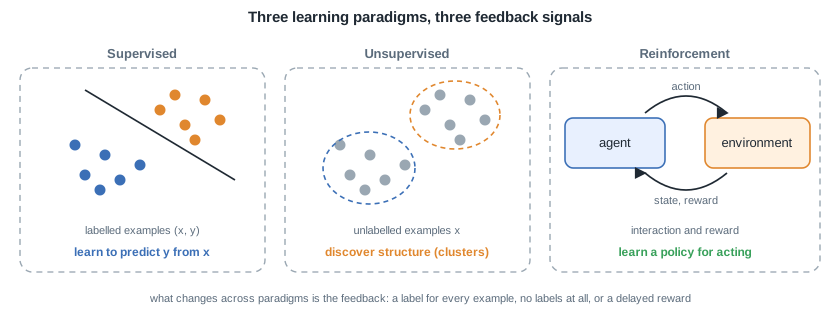
Machine learning problems are usually sorted into three paradigms. What separates them is not the algorithm but the feedback available during training: a label for every example, no labels at all, or a reward that arrives through interaction.
8
9
![The three types of learning](/en/Machine%20Learning/01%20Introduction/a/types-of-learning.svg)
10
11
*Supervised learning fits a mapping from labelled examples, unsupervised learning finds structure in unlabelled data, and reinforcement learning improves a policy through interaction with an environment.*
12
13
**Supervised learning.** Each training example pairs an input $x$ with the answer $y$ the model should produce, and the goal is a mapping $x \mapsto y$ that generalizes to inputs never seen in training. Predicting the price of a house from its features (regression) and deciding whether an email is spam (classification) are the canonical tasks. Labels make the objective explicit and progress measurable, which is why the theory is most developed here. Almost all of this course lives in this setting.
14
15
**Unsupervised learning.** Only the inputs $x$ are available, and no label says what the right answer is. The goal shifts from prediction to description: group similar customers into segments (clustering), compress many correlated features into a few informative directions (dimensionality reduction), or estimate which regions of the input space are likely (density estimation). Success is harder to quantify, because there is no ground truth to compare against.
16
17
**Reinforcement learning.** There is no fixed dataset at all. An agent takes an action, the environment returns a new state and a reward, and the reward may arrive long after the action that earned it. The goal is a policy, a rule for choosing actions that maximizes the cumulative reward. Game playing and robotics are the typical examples. It is a field of its own and sits outside the scope of this course.
18
19
| Paradigm | Data | Feedback signal | What is learned | Canonical tasks |
20
| --- | --- | --- | --- | --- |
21
| Supervised | pairs $(x, y)$ | the label $y$ | a mapping $h : x \mapsto y$ | regression, classification |
22
| Unsupervised | inputs $x$ only | none | structure in the data | clustering, dimensionality reduction |
23
| Reinforcement | interaction | reward, often delayed | a policy for acting | control, game playing |
24
25
*Remark:* the boundaries are not rigid. Semi-supervised learning mixes a few labelled examples with many unlabelled ones, and self-supervised learning manufactures labels from the data itself, for example by hiding a word and predicting it. Both reuse the supervised machinery introduced in this course.
26
6b31d5 lugonthier 2026-07-15 12:37:13
feat: Update "Decision trees and ensemble methods" module with new content and visuals - Revamped the introduction to ensemble methods, emphasizing the benefits of combining models. - Expanded sections on decision trees, bagging, and boosting, including detailed explanations and formulas. - Added new SVG diagrams illustrating the bagging process, the transition from stumps to trees, and variance reduction. - Introduced new images for AdaBoost rounds and variance reduction to enhance understanding.
27
## 1.2 The course notation
0ad9b6 lugonthier 2026-07-10 12:03:30
Remove "07 Regularization and high-dimensional inference" chapter and add "07 Support Vector Machines" and "08 Decision trees and ensemble methods" chapters with corresponding images.
28
6b31d5 lugonthier 2026-07-15 12:37:13
feat: Update "Decision trees and ensemble methods" module with new content and visuals - Revamped the introduction to ensemble methods, emphasizing the benefits of combining models. - Expanded sections on decision trees, bagging, and boosting, including detailed explanations and formulas. - Added new SVG diagrams illustrating the bagging process, the transition from stumps to trees, and variance reduction. - Introduced new images for AdaBoost rounds and variance reduction to enhance understanding.
29
### 1.2.1 Training set
1c3139 Lucas Gonthier 2026-06-30 12:04:21
Initial commit: course content (Machine Learning, MLOps) in EN and FR Co-Authored-By: Claude Opus 4.8 (1M context) <noreply@anthropic.com>
30
31
The training set is defined as a collection of $m$ labelled examples:
32
33
$$\boxed{ \{(x^{(i)}, y^{(i)})\}_{i=1}^{m} }$$
34
35
Symbols:
36
- $x^{(i)}$ is the input (feature vector) of the $i$-th example.
37
- $y^{(i)}$ is its target (label).
38
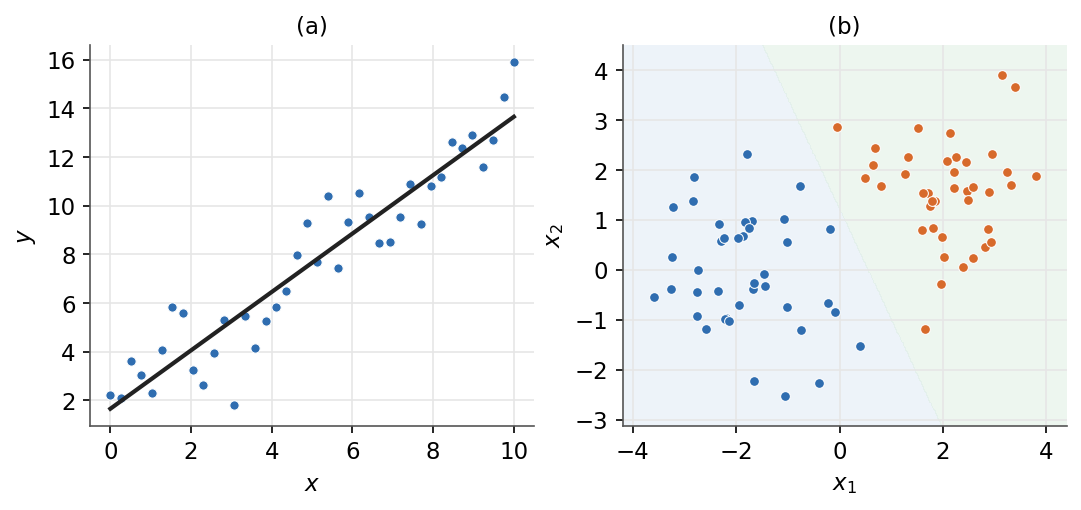
- $m$ is the number of training examples.
39
- $n$ is the number of features.
40
- $x_j^{(i)}$ is the $j$-th feature of the $i$-th example.
41
42
*Remark:* the superscript $(i)$ indexes the example and the subscript $j$ indexes the feature, so $x_j^{(i)}$ is feature $j$ of example $i$.
43
6b31d5 lugonthier 2026-07-15 12:37:13
feat: Update "Decision trees and ensemble methods" module with new content and visuals - Revamped the introduction to ensemble methods, emphasizing the benefits of combining models. - Expanded sections on decision trees, bagging, and boosting, including detailed explanations and formulas. - Added new SVG diagrams illustrating the bagging process, the transition from stumps to trees, and variance reduction. - Introduced new images for AdaBoost rounds and variance reduction to enhance understanding.
44
By convention the input is augmented with a constant intercept term $x_0 = 1$, so $x \in \mathbb{R}^{n+1}$ and the parameters are $w \in \mathbb{R}^{n+1}$.
1c3139 Lucas Gonthier 2026-06-30 12:04:21
Initial commit: course content (Machine Learning, MLOps) in EN and FR Co-Authored-By: Claude Opus 4.8 (1M context) <noreply@anthropic.com>
45
6b31d5 lugonthier 2026-07-15 12:37:13
feat: Update "Decision trees and ensemble methods" module with new content and visuals - Revamped the introduction to ensemble methods, emphasizing the benefits of combining models. - Expanded sections on decision trees, bagging, and boosting, including detailed explanations and formulas. - Added new SVG diagrams illustrating the bagging process, the transition from stumps to trees, and variance reduction. - Introduced new images for AdaBoost rounds and variance reduction to enhance understanding.
46
$$\boxed{ x_0 = 1, \quad x \in \mathbb{R}^{n+1}, \quad w \in \mathbb{R}^{n+1} }$$
1c3139 Lucas Gonthier 2026-06-30 12:04:21
Initial commit: course content (Machine Learning, MLOps) in EN and FR Co-Authored-By: Claude Opus 4.8 (1M context) <noreply@anthropic.com>
47
6b31d5 lugonthier 2026-07-15 12:37:13
feat: Update "Decision trees and ensemble methods" module with new content and visuals - Revamped the introduction to ensemble methods, emphasizing the benefits of combining models. - Expanded sections on decision trees, bagging, and boosting, including detailed explanations and formulas. - Added new SVG diagrams illustrating the bagging process, the transition from stumps to trees, and variance reduction. - Introduced new images for AdaBoost rounds and variance reduction to enhance understanding.
48
*Remark:* the intercept lets a single dot product $w^T x$ carry the bias term, so no separate constant has to be written.
1c3139 Lucas Gonthier 2026-06-30 12:04:21
Initial commit: course content (Machine Learning, MLOps) in EN and FR Co-Authored-By: Claude Opus 4.8 (1M context) <noreply@anthropic.com>
49
6b31d5 lugonthier 2026-07-15 12:37:13
feat: Update "Decision trees and ensemble methods" module with new content and visuals - Revamped the introduction to ensemble methods, emphasizing the benefits of combining models. - Expanded sections on decision trees, bagging, and boosting, including detailed explanations and formulas. - Added new SVG diagrams illustrating the bagging process, the transition from stumps to trees, and variance reduction. - Introduced new images for AdaBoost rounds and variance reduction to enhance understanding.
50
### 1.2.2 Hypothesis
1c3139 Lucas Gonthier 2026-06-30 12:04:21
Initial commit: course content (Machine Learning, MLOps) in EN and FR Co-Authored-By: Claude Opus 4.8 (1M context) <noreply@anthropic.com>
51
52
A hypothesis is defined as a function chosen from a model family that maps an input to a prediction:
53
6b31d5 lugonthier 2026-07-15 12:37:13
feat: Update "Decision trees and ensemble methods" module with new content and visuals - Revamped the introduction to ensemble methods, emphasizing the benefits of combining models. - Expanded sections on decision trees, bagging, and boosting, including detailed explanations and formulas. - Added new SVG diagrams illustrating the bagging process, the transition from stumps to trees, and variance reduction. - Introduced new images for AdaBoost rounds and variance reduction to enhance understanding.
54
$$\boxed{ h_w : x \mapsto \hat{y} = h_w(x) }$$
1c3139 Lucas Gonthier 2026-06-30 12:04:21
Initial commit: course content (Machine Learning, MLOps) in EN and FR Co-Authored-By: Claude Opus 4.8 (1M context) <noreply@anthropic.com>
55
6b31d5 lugonthier 2026-07-15 12:37:13
feat: Update "Decision trees and ensemble methods" module with new content and visuals - Revamped the introduction to ensemble methods, emphasizing the benefits of combining models. - Expanded sections on decision trees, bagging, and boosting, including detailed explanations and formulas. - Added new SVG diagrams illustrating the bagging process, the transition from stumps to trees, and variance reduction. - Introduced new images for AdaBoost rounds and variance reduction to enhance understanding.
56
Two notations, two roles: $h_w$ names the function, and $\hat{y}$ names the value it predicts for one input, the hat marking an estimate of the label $y$. Learning is the search, over the parameters $w$, for the hypothesis that best fits the training set.
1c3139 Lucas Gonthier 2026-06-30 12:04:21
Initial commit: course content (Machine Learning, MLOps) in EN and FR Co-Authored-By: Claude Opus 4.8 (1M context) <noreply@anthropic.com>
57
6b31d5 lugonthier 2026-07-15 12:37:13
feat: Update "Decision trees and ensemble methods" module with new content and visuals - Revamped the introduction to ensemble methods, emphasizing the benefits of combining models. - Expanded sections on decision trees, bagging, and boosting, including detailed explanations and formulas. - Added new SVG diagrams illustrating the bagging process, the transition from stumps to trees, and variance reduction. - Introduced new images for AdaBoost rounds and variance reduction to enhance understanding.
58
### 1.2.3 Design matrix
1c3139 Lucas Gonthier 2026-06-30 12:04:21
Initial commit: course content (Machine Learning, MLOps) in EN and FR Co-Authored-By: Claude Opus 4.8 (1M context) <noreply@anthropic.com>
59
60
The design matrix stacks the $m$ transposed inputs row by row, and the target vector collects the labels:
61
62
$$\boxed{ X = \begin{bmatrix} (x^{(1)})^{T} \\ \vdots \\ (x^{(m)})^{T} \end{bmatrix}, \quad y = \begin{bmatrix} y^{(1)} \\ \vdots \\ y^{(m)} \end{bmatrix} }$$
63
64
Here $X \in \mathbb{R}^{m \times (n+1)}$ (each augmented input is a row) and $y \in \mathbb{R}^{m}$.
65
6b31d5 lugonthier 2026-07-15 12:37:13
feat: Update "Decision trees and ensemble methods" module with new content and visuals - Revamped the introduction to ensemble methods, emphasizing the benefits of combining models. - Expanded sections on decision trees, bagging, and boosting, including detailed explanations and formulas. - Added new SVG diagrams illustrating the bagging process, the transition from stumps to trees, and variance reduction. - Introduced new images for AdaBoost rounds and variance reduction to enhance understanding.
66
*Remark:* with this layout many models reduce to compact matrix expressions, for example a linear prediction over all examples is $Xw$.
1c3139 Lucas Gonthier 2026-06-30 12:04:21
Initial commit: course content (Machine Learning, MLOps) in EN and FR Co-Authored-By: Claude Opus 4.8 (1M context) <noreply@anthropic.com>
67
6b31d5 lugonthier 2026-07-15 12:37:13
feat: Update "Decision trees and ensemble methods" module with new content and visuals - Revamped the introduction to ensemble methods, emphasizing the benefits of combining models. - Expanded sections on decision trees, bagging, and boosting, including detailed explanations and formulas. - Added new SVG diagrams illustrating the bagging process, the transition from stumps to trees, and variance reduction. - Introduced new images for AdaBoost rounds and variance reduction to enhance understanding.
68
## 1.3 Types of problems
1c3139 Lucas Gonthier 2026-06-30 12:04:21
Initial commit: course content (Machine Learning, MLOps) in EN and FR Co-Authored-By: Claude Opus 4.8 (1M context) <noreply@anthropic.com>
69
70
A supervised problem is named by the nature of its target $y$.
71
72
| Type | Target | Goal |
73
| --- | --- | --- |
74
| Regression | $y \in \mathbb{R}$ | predict a continuous value |
75
| Classification | $y \in \{1, \dots, k\}$ | predict one of $k$ discrete classes |
76
77
*Remark:* binary classification is the case $k = 2$, often coded as $y \in \{0, 1\}$ or $y \in \{-1, +1\}$.
78
79
![Regression versus classification](/en/Machine%20Learning/01%20Introduction/a/regression-vs-classification.png)
80
81
*Left: regression fits a continuous output. Right: classification separates the input space into classes.*
82
0ad9b6 lugonthier 2026-07-10 12:03:30
Remove "07 Regularization and high-dimensional inference" chapter and add "07 Support Vector Machines" and "08 Decision trees and ensemble methods" chapters with corresponding images.
83
*With the problem framed and the notation fixed, the next part turns to what learning really demands: minimizing a loss is easy, generalizing beyond the training set is the challenge.*
1c3139 Lucas Gonthier 2026-06-30 12:04:21
Initial commit: course content (Machine Learning, MLOps) in EN and FR Co-Authored-By: Claude Opus 4.8 (1M context) <noreply@anthropic.com>
84
85
---
86
Next: [General concepts](/en/Machine%20Learning/02%20General%20concepts) · [Course overview](/en/Machine%20Learning)