Blame

0ad9b6 lugonthier 2026-07-10 12:03:30
Remove "07 Regularization and high-dimensional inference" chapter and add "07 Support Vector Machines" and "08 Decision trees and ensemble methods" chapters with corresponding images.
1
# 5. Linear classification
2
6b31d5 lugonthier 2026-07-15 12:37:13
feat: Update "Decision trees and ensemble methods" module with new content and visuals - Revamped the introduction to ensemble methods, emphasizing the benefits of combining models. - Expanded sections on decision trees, bagging, and boosting, including detailed explanations and formulas. - Added new SVG diagrams illustrating the bagging process, the transition from stumps to trees, and variance reduction. - Introduced new images for AdaBoost rounds and variance reduction to enhance understanding.
3
Classification predicts a discrete label from the same linear score $w^T x$. This module surveys the classical linear classifiers as one menu: least squares, which assumes Gaussian-shaped classes and admits a closed form, and the perceptron and logistic regression, which assume nothing about the distribution and are fitted by gradient descent. Regularization closes the module.
0ad9b6 lugonthier 2026-07-10 12:03:30
Remove "07 Regularization and high-dimensional inference" chapter and add "07 Support Vector Machines" and "08 Decision trees and ensemble methods" chapters with corresponding images.
4
5
## 5.1 The linear separator
6
7
A linear classifier assigns the class from the sign of the linear score, and the set of inputs scoring zero is the decision boundary:
8
6b31d5 lugonthier 2026-07-15 12:37:13
feat: Update "Decision trees and ensemble methods" module with new content and visuals - Revamped the introduction to ensemble methods, emphasizing the benefits of combining models. - Expanded sections on decision trees, bagging, and boosting, including detailed explanations and formulas. - Added new SVG diagrams illustrating the bagging process, the transition from stumps to trees, and variance reduction. - Introduced new images for AdaBoost rounds and variance reduction to enhance understanding.
9
$$\boxed{ h_w(x) = \mathrm{sign}(w^T x), \qquad w^T x = 0 \ \text{is the boundary} }$$
0ad9b6 lugonthier 2026-07-10 12:03:30
Remove "07 Regularization and high-dimensional inference" chapter and add "07 Support Vector Machines" and "08 Decision trees and ensemble methods" chapters with corresponding images.
10
6b31d5 lugonthier 2026-07-15 12:37:13
feat: Update "Decision trees and ensemble methods" module with new content and visuals - Revamped the introduction to ensemble methods, emphasizing the benefits of combining models. - Expanded sections on decision trees, bagging, and boosting, including detailed explanations and formulas. - Added new SVG diagrams illustrating the bagging process, the transition from stumps to trees, and variance reduction. - Introduced new images for AdaBoost rounds and variance reduction to enhance understanding.
11
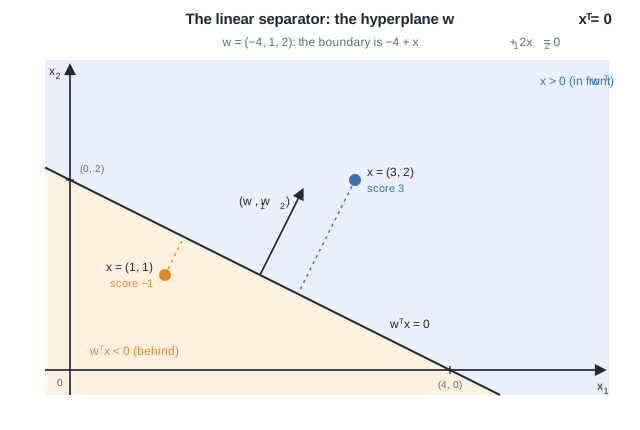
The boundary is a hyperplane: a line with two features, a plane with three. The sign of the score says on which side of the hyperplane the input falls, and its magnitude how far from the boundary it sits. With $w = (-4, 1, 2)$ (bias first, on the augmented input), the point $x = (3, 2)$ scores $-4 + 3 + 4 = 3$ and falls in front of the hyperplane, while $x = (1, 1)$ scores $-4 + 1 + 2 = -1$ and falls behind it.
0ad9b6 lugonthier 2026-07-10 12:03:30
Remove "07 Regularization and high-dimensional inference" chapter and add "07 Support Vector Machines" and "08 Decision trees and ensemble methods" chapters with corresponding images.
12
6b31d5 lugonthier 2026-07-15 12:37:13
feat: Update "Decision trees and ensemble methods" module with new content and visuals - Revamped the introduction to ensemble methods, emphasizing the benefits of combining models. - Expanded sections on decision trees, bagging, and boosting, including detailed explanations and formulas. - Added new SVG diagrams illustrating the bagging process, the transition from stumps to trees, and variance reduction. - Introduced new images for AdaBoost rounds and variance reduction to enhance understanding.
13
![The separating hyperplane](/en/Machine%20Learning/05%20Linear%20classification/a/hyperplane.svg)
0ad9b6 lugonthier 2026-07-10 12:03:30
Remove "07 Regularization and high-dimensional inference" chapter and add "07 Support Vector Machines" and "08 Decision trees and ensemble methods" chapters with corresponding images.
14
6b31d5 lugonthier 2026-07-15 12:37:13
feat: Update "Decision trees and ensemble methods" module with new content and visuals - Revamped the introduction to ensemble methods, emphasizing the benefits of combining models. - Expanded sections on decision trees, bagging, and boosting, including detailed explanations and formulas. - Added new SVG diagrams illustrating the bagging process, the transition from stumps to trees, and variance reduction. - Introduced new images for AdaBoost rounds and variance reduction to enhance understanding.
15
*The hyperplane $w^T x = 0$ splits the input space in two: with $w = (-4, 1, 2)$ the boundary is the line $-4 + x_1 + 2x_2 = 0$, normal to $(w_1, w_2)$. The point $(3, 2)$ scores $3$ and falls in front, $(1, 1)$ scores $-1$ and falls behind, and the magnitude of the score grows with the distance to the boundary (dotted).*
0ad9b6 lugonthier 2026-07-10 12:03:30
Remove "07 Regularization and high-dimensional inference" chapter and add "07 Support Vector Machines" and "08 Decision trees and ensemble methods" chapters with corresponding images.
16
6b31d5 lugonthier 2026-07-15 12:37:13
feat: Update "Decision trees and ensemble methods" module with new content and visuals - Revamped the introduction to ensemble methods, emphasizing the benefits of combining models. - Expanded sections on decision trees, bagging, and boosting, including detailed explanations and formulas. - Added new SVG diagrams illustrating the bagging process, the transition from stumps to trees, and variance reduction. - Introduced new images for AdaBoost rounds and variance reduction to enhance understanding.
17
*Remark:* two practical advantages follow. Once training is done the training set can be thrown away, and predicting costs a single dot product.
0ad9b6 lugonthier 2026-07-10 12:03:30
Remove "07 Regularization and high-dimensional inference" chapter and add "07 Support Vector Machines" and "08 Decision trees and ensemble methods" chapters with corresponding images.
18
6b31d5 lugonthier 2026-07-15 12:37:13
feat: Update "Decision trees and ensemble methods" module with new content and visuals - Revamped the introduction to ensemble methods, emphasizing the benefits of combining models. - Expanded sections on decision trees, bagging, and boosting, including detailed explanations and formulas. - Added new SVG diagrams illustrating the bagging process, the transition from stumps to trees, and variance reduction. - Introduced new images for AdaBoost rounds and variance reduction to enhance understanding.
19
## 5.2 Least squares as a classifier
0ad9b6 lugonthier 2026-07-10 12:03:30
Remove "07 Regularization and high-dimensional inference" chapter and add "07 Support Vector Machines" and "08 Decision trees and ensemble methods" chapters with corresponding images.
20
21
Code the two classes as $y \in \{-1, +1\}$, treat them as regression targets, and everything from [Linear regression](/en/Machine%20Learning/04%20Linear%20regression) applies verbatim, closed form included:
22
6b31d5 lugonthier 2026-07-15 12:37:13
feat: Update "Decision trees and ensemble methods" module with new content and visuals - Revamped the introduction to ensemble methods, emphasizing the benefits of combining models. - Expanded sections on decision trees, bagging, and boosting, including detailed explanations and formulas. - Added new SVG diagrams illustrating the bagging process, the transition from stumps to trees, and variance reduction. - Introduced new images for AdaBoost rounds and variance reduction to enhance understanding.
23
$$\boxed{ w = (X^T X)^{-1}X^T y, \qquad h_w(x) = \mathrm{sign}(w^T x) }$$
0ad9b6 lugonthier 2026-07-10 12:03:30
Remove "07 Regularization and high-dimensional inference" chapter and add "07 Support Vector Machines" and "08 Decision trees and ensemble methods" chapters with corresponding images.
24
25
For $K > 2$ classes, code each label as a one-hot row of $Y \in \mathbb{R}^{m \times K}$ and reuse the multiple-output regression of [Linear regression](/en/Machine%20Learning/04%20Linear%20regression), predicting the class with the highest score:
26
27
$$\boxed{ W = (X^T X)^{-1}X^T Y, \qquad \hat{y} = \arg\max_k \; (W^T x)_k }$$
28
29
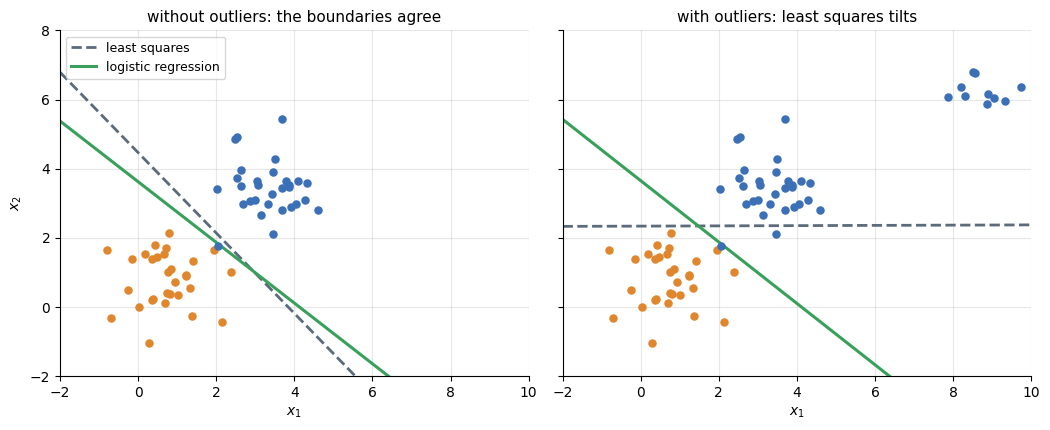
It can work, but the squared loss penalizes large scores even deep on the correct side, so the points least in doubt pull on the boundary. That is the Gaussian assumption at work: least squares treats the labels as Gaussian targets, and data far from that story breaks it.
30
31
![Least squares versus logistic regression with outliers](/en/Machine%20Learning/05%20Linear%20classification/a/least-squares-outliers.png)
32
33
*Without outliers least squares and logistic regression agree. Adding distant, correctly classified points tilts the least-squares boundary into errors, while logistic regression barely moves.*
34
6b31d5 lugonthier 2026-07-15 12:37:13
feat: Update "Decision trees and ensemble methods" module with new content and visuals - Revamped the introduction to ensemble methods, emphasizing the benefits of combining models. - Expanded sections on decision trees, bagging, and boosting, including detailed explanations and formulas. - Added new SVG diagrams illustrating the bagging process, the transition from stumps to trees, and variance reduction. - Introduced new images for AdaBoost rounds and variance reduction to enhance understanding.
35
## 5.3 The perceptron
0ad9b6 lugonthier 2026-07-10 12:03:30
Remove "07 Regularization and high-dimensional inference" chapter and add "07 Support Vector Machines" and "08 Decision trees and ensemble methods" chapters with corresponding images.
36
6b31d5 lugonthier 2026-07-15 12:37:13
feat: Update "Decision trees and ensemble methods" module with new content and visuals - Revamped the introduction to ensemble methods, emphasizing the benefits of combining models. - Expanded sections on decision trees, bagging, and boosting, including detailed explanations and formulas. - Added new SVG diagrams illustrating the bagging process, the transition from stumps to trees, and variance reduction. - Introduced new images for AdaBoost rounds and variance reduction to enhance understanding.
37
### 5.3.1 The model: one neuron
0ad9b6 lugonthier 2026-07-10 12:03:30
Remove "07 Regularization and high-dimensional inference" chapter and add "07 Support Vector Machines" and "08 Decision trees and ensemble methods" chapters with corresponding images.
38
39
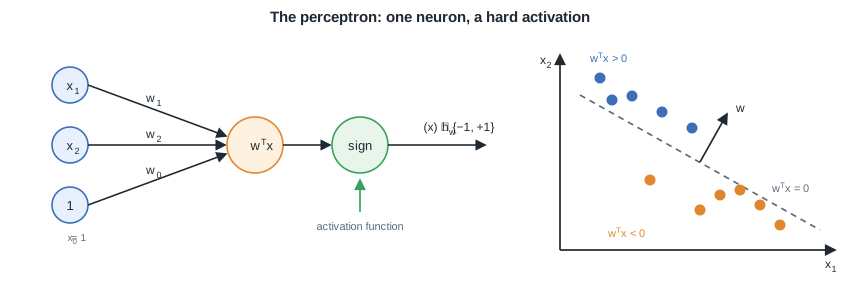
The first assumption-free method takes the definition of a linear classifier at face value, a dot product followed by a hard activation, the historical neuron:
40
6b31d5 lugonthier 2026-07-15 12:37:13
feat: Update "Decision trees and ensemble methods" module with new content and visuals - Revamped the introduction to ensemble methods, emphasizing the benefits of combining models. - Expanded sections on decision trees, bagging, and boosting, including detailed explanations and formulas. - Added new SVG diagrams illustrating the bagging process, the transition from stumps to trees, and variance reduction. - Introduced new images for AdaBoost rounds and variance reduction to enhance understanding.
41
$$\boxed{ h_w(x) = \mathrm{sign}(w^T x), \qquad y \in \{-1, +1\} }$$
0ad9b6 lugonthier 2026-07-10 12:03:30
Remove "07 Regularization and high-dimensional inference" chapter and add "07 Support Vector Machines" and "08 Decision trees and ensemble methods" chapters with corresponding images.
42
43
![The perceptron as a neuron](/en/Machine%20Learning/05%20Linear%20classification/a/perceptron-neuron.svg)
44
6b31d5 lugonthier 2026-07-15 12:37:13
feat: Update "Decision trees and ensemble methods" module with new content and visuals - Revamped the introduction to ensemble methods, emphasizing the benefits of combining models. - Expanded sections on decision trees, bagging, and boosting, including detailed explanations and formulas. - Added new SVG diagrams illustrating the bagging process, the transition from stumps to trees, and variance reduction. - Introduced new images for AdaBoost rounds and variance reduction to enhance understanding.
45
*Left: the perceptron is a single neuron, the weighted inputs summed into the score $w^T x$ and passed through a hard sign activation. Right: that sign splits the input space along the hyperplane $w^T x = 0$.*
0ad9b6 lugonthier 2026-07-10 12:03:30
Remove "07 Regularization and high-dimensional inference" chapter and add "07 Support Vector Machines" and "08 Decision trees and ensemble methods" chapters with corresponding images.
46
6b31d5 lugonthier 2026-07-15 12:37:13
feat: Update "Decision trees and ensemble methods" module with new content and visuals - Revamped the introduction to ensemble methods, emphasizing the benefits of combining models. - Expanded sections on decision trees, bagging, and boosting, including detailed explanations and formulas. - Added new SVG diagrams illustrating the bagging process, the transition from stumps to trees, and variance reduction. - Introduced new images for AdaBoost rounds and variance reduction to enhance understanding.
47
### 5.3.2 The loss function: the perceptron criterion
0ad9b6 lugonthier 2026-07-10 12:03:30
Remove "07 Regularization and high-dimensional inference" chapter and add "07 Support Vector Machines" and "08 Decision trees and ensemble methods" chapters with corresponding images.
48
6b31d5 lugonthier 2026-07-15 12:37:13
feat: Update "Decision trees and ensemble methods" module with new content and visuals - Revamped the introduction to ensemble methods, emphasizing the benefits of combining models. - Expanded sections on decision trees, bagging, and boosting, including detailed explanations and formulas. - Added new SVG diagrams illustrating the bagging process, the transition from stumps to trees, and variance reduction. - Introduced new images for AdaBoost rounds and variance reduction to enhance understanding.
49
Fitting needs a loss, and counting mistakes does not work: the count is piecewise constant, so its gradient is zero almost everywhere. The perceptron criterion instead penalizes each misclassified point by how far it sits on the wrong side. A mistake means $y^{(i)}\,w^T x^{(i)} < 0$, so over the set $\mathcal{M}$ of misclassified points:
0ad9b6 lugonthier 2026-07-10 12:03:30
Remove "07 Regularization and high-dimensional inference" chapter and add "07 Support Vector Machines" and "08 Decision trees and ensemble methods" chapters with corresponding images.
50
6b31d5 lugonthier 2026-07-15 12:37:13
feat: Update "Decision trees and ensemble methods" module with new content and visuals - Revamped the introduction to ensemble methods, emphasizing the benefits of combining models. - Expanded sections on decision trees, bagging, and boosting, including detailed explanations and formulas. - Added new SVG diagrams illustrating the bagging process, the transition from stumps to trees, and variance reduction. - Introduced new images for AdaBoost rounds and variance reduction to enhance understanding.
51
$$\boxed{ E(w) = -\sum_{i \in \mathcal{M}} y^{(i)}\, w^T x^{(i)} }$$
0ad9b6 lugonthier 2026-07-10 12:03:30
Remove "07 Regularization and high-dimensional inference" chapter and add "07 Support Vector Machines" and "08 Decision trees and ensemble methods" chapters with corresponding images.
52
6b31d5 lugonthier 2026-07-15 12:37:13
feat: Update "Decision trees and ensemble methods" module with new content and visuals - Revamped the introduction to ensemble methods, emphasizing the benefits of combining models. - Expanded sections on decision trees, bagging, and boosting, including detailed explanations and formulas. - Added new SVG diagrams illustrating the bagging process, the transition from stumps to trees, and variance reduction. - Introduced new images for AdaBoost rounds and variance reduction to enhance understanding.
53
always positive and piecewise linear.
54
55
### 5.3.3 Optimization: gradient descent
56
57
Minimizing the criterion introduces the workhorse of everything in this course that lacks a closed form, gradient descent: repeatedly step the parameters against the gradient of the loss, scaled by a learning rate $\alpha > 0$:
58
59
$$\boxed{\,w \leftarrow w - \alpha\,\nabla_w E(w)\,}$$
0ad9b6 lugonthier 2026-07-10 12:03:30
Remove "07 Regularization and high-dimensional inference" chapter and add "07 Support Vector Machines" and "08 Decision trees and ensemble methods" chapters with corresponding images.
60
61
The batch variant computes the gradient over the whole training set before each step, a smooth descent that reads every example every time. The stochastic variant (SGD) steps on one example at a time, cheap and noisy, and is the default on large datasets. If $\alpha$ is too large the iterates can diverge, if too small convergence crawls.
62
12d21f lugonthier 2026-07-24 11:49:19
Remove unused SVG files and update Markdown content for clarity and accuracy in MLOps and Machine Learning modules. Adjust references to optimization techniques and activation functions, and enhance explanations in the mathematical refresher section.
63
*Remark:* fancier optimizers exist, momentum, Adam and their cousins, refinements of this same rule that matter for deep networks ([Optimization](/en/Deep%20Learning/03%20Optimization) in the Deep Learning course). Everything in this module needs only the plain version.
0ad9b6 lugonthier 2026-07-10 12:03:30
Remove "07 Regularization and high-dimensional inference" chapter and add "07 Support Vector Machines" and "08 Decision trees and ensemble methods" chapters with corresponding images.
64
65
On a single misclassified example the gradient of the criterion is $-y^{(i)} x^{(i)}$, so the stochastic step is the perceptron update: on a mistake,
66
6b31d5 lugonthier 2026-07-15 12:37:13
feat: Update "Decision trees and ensemble methods" module with new content and visuals - Revamped the introduction to ensemble methods, emphasizing the benefits of combining models. - Expanded sections on decision trees, bagging, and boosting, including detailed explanations and formulas. - Added new SVG diagrams illustrating the bagging process, the transition from stumps to trees, and variance reduction. - Introduced new images for AdaBoost rounds and variance reduction to enhance understanding.
67
$$\boxed{ w \leftarrow w + \alpha\, y^{(i)} x^{(i)} }$$
0ad9b6 lugonthier 2026-07-10 12:03:30
Remove "07 Regularization and high-dimensional inference" chapter and add "07 Support Vector Machines" and "08 Decision trees and ensemble methods" chapters with corresponding images.
68
6b31d5 lugonthier 2026-07-15 12:37:13
feat: Update "Decision trees and ensemble methods" module with new content and visuals - Revamped the introduction to ensemble methods, emphasizing the benefits of combining models. - Expanded sections on decision trees, bagging, and boosting, including detailed explanations and formulas. - Added new SVG diagrams illustrating the bagging process, the transition from stumps to trees, and variance reduction. - Introduced new images for AdaBoost rounds and variance reduction to enhance understanding.
69
and no update otherwise. In the $\{0, 1\}$ coding this is the residual-times-input update $w_j \leftarrow w_j + \alpha\,(y^{(i)} - h_w(x^{(i)}))\,x_j^{(i)}$.
0ad9b6 lugonthier 2026-07-10 12:03:30
Remove "07 Regularization and high-dimensional inference" chapter and add "07 Support Vector Machines" and "08 Decision trees and ensemble methods" chapters with corresponding images.
70
71
![Perceptron decision boundary](/en/Machine%20Learning/05%20Linear%20classification/a/perceptron.png)
72
81a3ca lugonthier 2026-07-28 13:29:31
slide 01
73
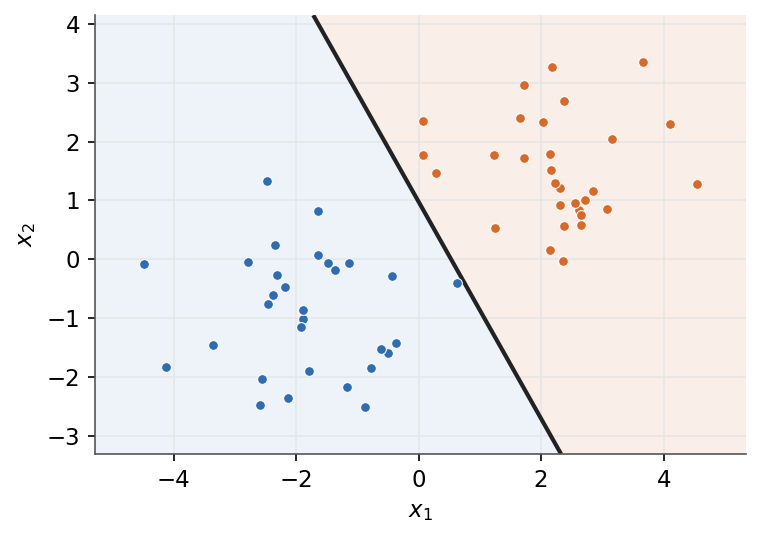
*The perceptron finds one separating hyperplane, not necessarily the one with the widest margin.*
0ad9b6 lugonthier 2026-07-10 12:03:30
Remove "07 Regularization and high-dimensional inference" chapter and add "07 Support Vector Machines" and "08 Decision trees and ensemble methods" chapters with corresponding images.
74
6b31d5 lugonthier 2026-07-15 12:37:13
feat: Update "Decision trees and ensemble methods" module with new content and visuals - Revamped the introduction to ensemble methods, emphasizing the benefits of combining models. - Expanded sections on decision trees, bagging, and boosting, including detailed explanations and formulas. - Added new SVG diagrams illustrating the bagging process, the transition from stumps to trees, and variance reduction. - Introduced new images for AdaBoost rounds and variance reduction to enhance understanding.
75
### 5.3.4 Multiclass perceptron
0ad9b6 lugonthier 2026-07-10 12:03:30
Remove "07 Regularization and high-dimensional inference" chapter and add "07 Support Vector Machines" and "08 Decision trees and ensemble methods" chapters with corresponding images.
76
6b31d5 lugonthier 2026-07-15 12:37:13
feat: Update "Decision trees and ensemble methods" module with new content and visuals - Revamped the introduction to ensemble methods, emphasizing the benefits of combining models. - Expanded sections on decision trees, bagging, and boosting, including detailed explanations and formulas. - Added new SVG diagrams illustrating the bagging process, the transition from stumps to trees, and variance reduction. - Introduced new images for AdaBoost rounds and variance reduction to enhance understanding.
77
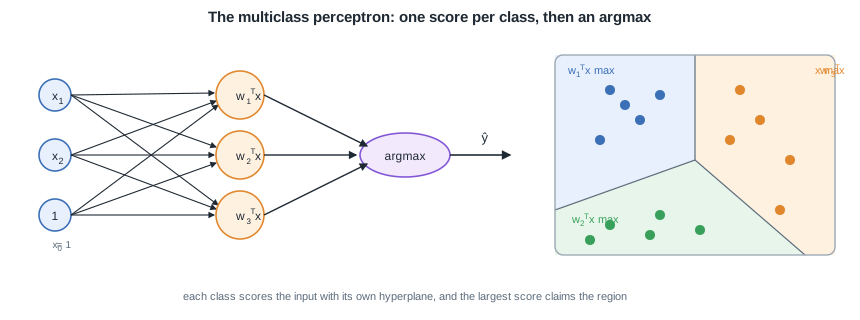
With $k$ classes, keep one weight vector $w_c$ per class and predict the highest-scoring one. On a mistake, reward the true class and penalize the predicted one:
0ad9b6 lugonthier 2026-07-10 12:03:30
Remove "07 Regularization and high-dimensional inference" chapter and add "07 Support Vector Machines" and "08 Decision trees and ensemble methods" chapters with corresponding images.
78
6b31d5 lugonthier 2026-07-15 12:37:13
feat: Update "Decision trees and ensemble methods" module with new content and visuals - Revamped the introduction to ensemble methods, emphasizing the benefits of combining models. - Expanded sections on decision trees, bagging, and boosting, including detailed explanations and formulas. - Added new SVG diagrams illustrating the bagging process, the transition from stumps to trees, and variance reduction. - Introduced new images for AdaBoost rounds and variance reduction to enhance understanding.
79
$$\boxed{ \hat{y} = \arg\max_c w_c^T x, \qquad w_{y} \mathrel{+}= \alpha x, \quad w_{\hat{y}} \mathrel{-}= \alpha x }$$
0ad9b6 lugonthier 2026-07-10 12:03:30
Remove "07 Regularization and high-dimensional inference" chapter and add "07 Support Vector Machines" and "08 Decision trees and ensemble methods" chapters with corresponding images.
80
6b31d5 lugonthier 2026-07-15 12:37:13
feat: Update "Decision trees and ensemble methods" module with new content and visuals - Revamped the introduction to ensemble methods, emphasizing the benefits of combining models. - Expanded sections on decision trees, bagging, and boosting, including detailed explanations and formulas. - Added new SVG diagrams illustrating the bagging process, the transition from stumps to trees, and variance reduction. - Introduced new images for AdaBoost rounds and variance reduction to enhance understanding.
81
The network view extends naturally: one score neuron per class, and an argmax where the binary perceptron had a sign. Gathering the $w_c$ as the columns of a matrix $W \in \mathbb{R}^{(n+1) \times k}$, one product $W^T x$ computes every score at once, and the scores carve the input space into $k$ regions, each claimed by the class whose score is largest.
0ad9b6 lugonthier 2026-07-10 12:03:30
Remove "07 Regularization and high-dimensional inference" chapter and add "07 Support Vector Machines" and "08 Decision trees and ensemble methods" chapters with corresponding images.
82
83
![The multiclass perceptron](/en/Machine%20Learning/05%20Linear%20classification/a/multiclass-neuron.svg)
84
85
*One score neuron per class and an argmax on top. Each column of $W$ (each row of $W^T$) is the hyperplane, normal and bias, of one class.*
86
87
A worked example with $k = 3$ classes and the input $x = (1.1, -2.0)$, augmented with $x_0 = 1$:
88
89
$$ W^T x = \begin{bmatrix} -2 & -4 & 1 \\ -4 & 2 & 4 \\ -6 & 4 & -5 \end{bmatrix}\begin{bmatrix} 1 \\ 1.1 \\ -2.0 \end{bmatrix} = \begin{bmatrix} -8.4 \\ -9.8 \\ 8.4 \end{bmatrix} $$
90
6b31d5 lugonthier 2026-07-15 12:37:13
feat: Update "Decision trees and ensemble methods" module with new content and visuals - Revamped the introduction to ensemble methods, emphasizing the benefits of combining models. - Expanded sections on decision trees, bagging, and boosting, including detailed explanations and formulas. - Added new SVG diagrams illustrating the bagging process, the transition from stumps to trees, and variance reduction. - Introduced new images for AdaBoost rounds and variance reduction to enhance understanding.
91
The third score wins, so the input is assigned to class 3. Reading off the third row, that score is $w_3^T x = -6 + 4 \times 1.1 + (-5) \times (-2.0) = 8.4$.
0ad9b6 lugonthier 2026-07-10 12:03:30
Remove "07 Regularization and high-dimensional inference" chapter and add "07 Support Vector Machines" and "08 Decision trees and ensemble methods" chapters with corresponding images.
92
6b31d5 lugonthier 2026-07-15 12:37:13
feat: Update "Decision trees and ensemble methods" module with new content and visuals - Revamped the introduction to ensemble methods, emphasizing the benefits of combining models. - Expanded sections on decision trees, bagging, and boosting, including detailed explanations and formulas. - Added new SVG diagrams illustrating the bagging process, the transition from stumps to trees, and variance reduction. - Introduced new images for AdaBoost rounds and variance reduction to enhance understanding.
93
### 5.3.5 Convergence and limits
0ad9b6 lugonthier 2026-07-10 12:03:30
Remove "07 Regularization and high-dimensional inference" chapter and add "07 Support Vector Machines" and "08 Decision trees and ensemble methods" chapters with corresponding images.
94
95
If the data is linearly separable the perceptron converges in a finite number of updates, otherwise the weights oscillate forever. And since the criterion is zero on every separating hyperplane, all of them count as "optimal", including those that graze the data.
96
81a3ca lugonthier 2026-07-28 13:29:31
slide 01
97
*Remark:* two upgrades fix these limits, and each one opens a module. A smooth activation and loss give logistic regression, next section. Stacking neurons into layers gives [multilayer neural networks](/en/Machine%20Learning/06%20Multilayer%20neural%20networks), the starting point of the Deep Learning course.
0ad9b6 lugonthier 2026-07-10 12:03:30
Remove "07 Regularization and high-dimensional inference" chapter and add "07 Support Vector Machines" and "08 Decision trees and ensemble methods" chapters with corresponding images.
98
6b31d5 lugonthier 2026-07-15 12:37:13
feat: Update "Decision trees and ensemble methods" module with new content and visuals - Revamped the introduction to ensemble methods, emphasizing the benefits of combining models. - Expanded sections on decision trees, bagging, and boosting, including detailed explanations and formulas. - Added new SVG diagrams illustrating the bagging process, the transition from stumps to trees, and variance reduction. - Introduced new images for AdaBoost rounds and variance reduction to enhance understanding.
99
## 5.4 Logistic regression
0ad9b6 lugonthier 2026-07-10 12:03:30
Remove "07 Regularization and high-dimensional inference" chapter and add "07 Support Vector Machines" and "08 Decision trees and ensemble methods" chapters with corresponding images.
100
6b31d5 lugonthier 2026-07-15 12:37:13
feat: Update "Decision trees and ensemble methods" module with new content and visuals - Revamped the introduction to ensemble methods, emphasizing the benefits of combining models. - Expanded sections on decision trees, bagging, and boosting, including detailed explanations and formulas. - Added new SVG diagrams illustrating the bagging process, the transition from stumps to trees, and variance reduction. - Introduced new images for AdaBoost rounds and variance reduction to enhance understanding.
101
### 5.4.1 The model: a smooth activation
0ad9b6 lugonthier 2026-07-10 12:03:30
Remove "07 Regularization and high-dimensional inference" chapter and add "07 Support Vector Machines" and "08 Decision trees and ensemble methods" chapters with corresponding images.
102
6b31d5 lugonthier 2026-07-15 12:37:13
feat: Update "Decision trees and ensemble methods" module with new content and visuals - Revamped the introduction to ensemble methods, emphasizing the benefits of combining models. - Expanded sections on decision trees, bagging, and boosting, including detailed explanations and formulas. - Added new SVG diagrams illustrating the bagging process, the transition from stumps to trees, and variance reduction. - Introduced new images for AdaBoost rounds and variance reduction to enhance understanding.
103
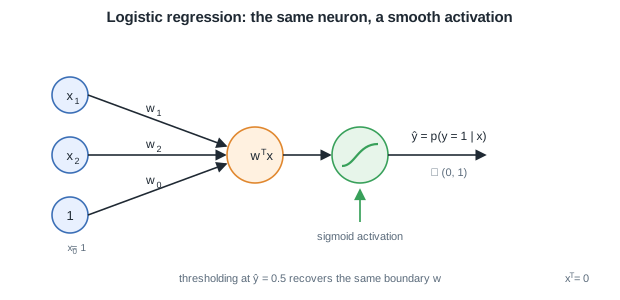
Logistic regression keeps the neuron but replaces the hard step with the smooth sigmoid, so the output is the probability of the positive class ($y \in \{0, 1\}$). It is still written $\hat{y}$, but the estimate of the label is now soft: the perceptron's $\hat{y}$ was a hard class, logistic regression's is a probability, and thresholding it at $\tfrac{1}{2}$ turns it back into a class whenever one is needed:
0ad9b6 lugonthier 2026-07-10 12:03:30
Remove "07 Regularization and high-dimensional inference" chapter and add "07 Support Vector Machines" and "08 Decision trees and ensemble methods" chapters with corresponding images.
104
6b31d5 lugonthier 2026-07-15 12:37:13
feat: Update "Decision trees and ensemble methods" module with new content and visuals - Revamped the introduction to ensemble methods, emphasizing the benefits of combining models. - Expanded sections on decision trees, bagging, and boosting, including detailed explanations and formulas. - Added new SVG diagrams illustrating the bagging process, the transition from stumps to trees, and variance reduction. - Introduced new images for AdaBoost rounds and variance reduction to enhance understanding.
105
$$\boxed{ \hat{y} = p(y = 1 \mid x; w) = \sigma(w^T x) = \frac{1}{1 + e^{-w^T x}} }$$
0ad9b6 lugonthier 2026-07-10 12:03:30
Remove "07 Regularization and high-dimensional inference" chapter and add "07 Support Vector Machines" and "08 Decision trees and ensemble methods" chapters with corresponding images.
106
107
![Logistic regression as a neuron](/en/Machine%20Learning/05%20Linear%20classification/a/logistic-neuron.svg)
108
6b31d5 lugonthier 2026-07-15 12:37:13
feat: Update "Decision trees and ensemble methods" module with new content and visuals - Revamped the introduction to ensemble methods, emphasizing the benefits of combining models. - Expanded sections on decision trees, bagging, and boosting, including detailed explanations and formulas. - Added new SVG diagrams illustrating the bagging process, the transition from stumps to trees, and variance reduction. - Introduced new images for AdaBoost rounds and variance reduction to enhance understanding.
109
*The same neuron with the step swapped for the sigmoid: the output becomes the probability $\hat{y} = p(y = 1 \mid x)$, and thresholding it at $\tfrac{1}{2}$ recovers the same boundary $w^T x = 0$.*
0ad9b6 lugonthier 2026-07-10 12:03:30
Remove "07 Regularization and high-dimensional inference" chapter and add "07 Support Vector Machines" and "08 Decision trees and ensemble methods" chapters with corresponding images.
110
111
*Remark:* the sigmoid is not an arbitrary squashing choice. Writing the posterior with Bayes' rule gives $p(C_1 \mid x) = 1/(1 + e^{-a})$ with $a = \ln \frac{p(x \mid C_1)\,p(C_1)}{p(x \mid C_0)\,p(C_0)}$, so a well-trained logistic output is exactly a posterior probability.
112
6b31d5 lugonthier 2026-07-15 12:37:13
feat: Update "Decision trees and ensemble methods" module with new content and visuals - Revamped the introduction to ensemble methods, emphasizing the benefits of combining models. - Expanded sections on decision trees, bagging, and boosting, including detailed explanations and formulas. - Added new SVG diagrams illustrating the bagging process, the transition from stumps to trees, and variance reduction. - Introduced new images for AdaBoost rounds and variance reduction to enhance understanding.
113
### 5.4.2 The loss function: cross-entropy
0ad9b6 lugonthier 2026-07-10 12:03:30
Remove "07 Regularization and high-dimensional inference" chapter and add "07 Support Vector Machines" and "08 Decision trees and ensemble methods" chapters with corresponding images.
114
115
The likelihood of Bernoulli labels, taken through $-\log$, gives the cross-entropy loss:
116
6b31d5 lugonthier 2026-07-15 12:37:13
feat: Update "Decision trees and ensemble methods" module with new content and visuals - Revamped the introduction to ensemble methods, emphasizing the benefits of combining models. - Expanded sections on decision trees, bagging, and boosting, including detailed explanations and formulas. - Added new SVG diagrams illustrating the bagging process, the transition from stumps to trees, and variance reduction. - Introduced new images for AdaBoost rounds and variance reduction to enhance understanding.
117
$$\boxed{ L(w) = -\sum_{i=1}^{m}\left[ y^{(i)}\log \hat{y}^{(i)} + (1 - y^{(i)})\log(1 - \hat{y}^{(i)}) \right] }$$
118
119
<details class="proof">
120
<summary>Proof: maximum likelihood gives the cross-entropy</summary>
121
122
The model says each label is a Bernoulli draw with success probability $\hat{y}^{(i)} = \sigma(w^T x^{(i)})$, and both cases fold into one expression:
123
124
$$p(y^{(i)} \mid x^{(i)}; w) = \left(\hat{y}^{(i)}\right)^{y^{(i)}}\left(1 - \hat{y}^{(i)}\right)^{1 - y^{(i)}}$$
125
126
since $y^{(i)} \in \{0, 1\}$ selects the factor: the expression is $\hat{y}^{(i)}$ when $y^{(i)} = 1$ and $1 - \hat{y}^{(i)}$ when $y^{(i)} = 0$. The examples are i.i.d., so the likelihood of the training set factorizes, as it did in [Linear regression](/en/Machine%20Learning/04%20Linear%20regression):
127
128
$$p(y \mid X; w) = \prod_{i=1}^{m} \left(\hat{y}^{(i)}\right)^{y^{(i)}}\left(1 - \hat{y}^{(i)}\right)^{1 - y^{(i)}}$$
129
130
The logarithm preserves the argmax, turns the product into a sum and brings the exponents down:
131
132
$$\ell(w) = \sum_{i=1}^{m}\left[ y^{(i)}\log \hat{y}^{(i)} + (1 - y^{(i)})\log(1 - \hat{y}^{(i)}) \right]$$
133
134
Maximizing $\ell$ is minimizing $-\ell$, which is exactly $L(w)$. The cross-entropy is the negative Bernoulli log-likelihood, the same estimation principle that made least squares the answer under Gaussian noise. $\blacksquare$
135
136
</details>
137
138
### 5.4.3 Optimization: gradient descent
0ad9b6 lugonthier 2026-07-10 12:03:30
Remove "07 Regularization and high-dimensional inference" chapter and add "07 Support Vector Machines" and "08 Decision trees and ensemble methods" chapters with corresponding images.
139
140
Unlike least squares, this loss has no closed-form minimizer: the sigmoid makes the stationarity equations transcendental, so the fit falls to the same gradient descent as the perceptron. Differentiating the cross-entropy through the sigmoid rewards the effort: almost everything cancels and the gradient collapses to the residual times the input:
141
6b31d5 lugonthier 2026-07-15 12:37:13
feat: Update "Decision trees and ensemble methods" module with new content and visuals - Revamped the introduction to ensemble methods, emphasizing the benefits of combining models. - Expanded sections on decision trees, bagging, and boosting, including detailed explanations and formulas. - Added new SVG diagrams illustrating the bagging process, the transition from stumps to trees, and variance reduction. - Introduced new images for AdaBoost rounds and variance reduction to enhance understanding.
142
$$\boxed{ w_j \leftarrow w_j - \alpha \sum_{i=1}^{m}\left(\hat{y}^{(i)} - y^{(i)}\right)x_j^{(i)} }$$
143
144
<details class="proof">
145
<summary>Proof: the gradient collapses to the residual times the input</summary>
146
147
Write the score $z^{(i)} = w^T x^{(i)}$, so that $\hat{y}^{(i)} = \sigma(z^{(i)})$. The derivation rests on one identity, the sigmoid differentiating into itself:
0ad9b6 lugonthier 2026-07-10 12:03:30
Remove "07 Regularization and high-dimensional inference" chapter and add "07 Support Vector Machines" and "08 Decision trees and ensemble methods" chapters with corresponding images.
148
6b31d5 lugonthier 2026-07-15 12:37:13
feat: Update "Decision trees and ensemble methods" module with new content and visuals - Revamped the introduction to ensemble methods, emphasizing the benefits of combining models. - Expanded sections on decision trees, bagging, and boosting, including detailed explanations and formulas. - Added new SVG diagrams illustrating the bagging process, the transition from stumps to trees, and variance reduction. - Introduced new images for AdaBoost rounds and variance reduction to enhance understanding.
149
$$\sigma'(z) = \frac{e^{-z}}{\left(1 + e^{-z}\right)^2} = \frac{1}{1 + e^{-z}} \cdot \frac{e^{-z}}{1 + e^{-z}} = \sigma(z)\left(1 - \sigma(z)\right)$$
150
151
since $\tfrac{e^{-z}}{1 + e^{-z}} = 1 - \sigma(z)$. Now take the loss of a single example, $L^{(i)} = -\left[y^{(i)}\log \hat{y}^{(i)} + (1 - y^{(i)})\log(1 - \hat{y}^{(i)})\right]$, and follow the chain rule through its three stages, loss to output, output to score, score to weight:
152
153
$$\frac{\partial L^{(i)}}{\partial \hat{y}^{(i)}} = -\frac{y^{(i)}}{\hat{y}^{(i)}} + \frac{1 - y^{(i)}}{1 - \hat{y}^{(i)}} = \frac{\hat{y}^{(i)} - y^{(i)}}{\hat{y}^{(i)}\left(1 - \hat{y}^{(i)}\right)}, \qquad \frac{\partial \hat{y}^{(i)}}{\partial z^{(i)}} = \hat{y}^{(i)}\left(1 - \hat{y}^{(i)}\right), \qquad \frac{\partial z^{(i)}}{\partial w_j} = x_j^{(i)}$$
154
155
(the first equality puts the two fractions over the common denominator $\hat{y}^{(i)}(1 - \hat{y}^{(i)})$, and the second is the sigmoid identity above). Multiplying the three, the denominator of the first factor is exactly the second factor, and everything cancels:
156
157
$$\frac{\partial L^{(i)}}{\partial w_j} = \frac{\hat{y}^{(i)} - y^{(i)}}{\hat{y}^{(i)}\left(1 - \hat{y}^{(i)}\right)} \cdot \hat{y}^{(i)}\left(1 - \hat{y}^{(i)}\right) \cdot x_j^{(i)} = \left(\hat{y}^{(i)} - y^{(i)}\right) x_j^{(i)}$$
158
159
Summing over the training set gives $\partial L / \partial w_j = \sum_{i=1}^{m} (\hat{y}^{(i)} - y^{(i)})\, x_j^{(i)}$, and plugging this gradient into the descent rule $w \leftarrow w - \alpha\, \nabla_w L$ is the boxed update. $\blacksquare$
160
161
</details>
162
163
*Remark:* unlike the perceptron, the gradient involves every training point, not only the misclassified ones: each point pulls in proportion to its residual $\hat{y}^{(i)} - y^{(i)}$. That is what makes logistic regression more stable than the perceptron and usable on non-separable data.
0ad9b6 lugonthier 2026-07-10 12:03:30
Remove "07 Regularization and high-dimensional inference" chapter and add "07 Support Vector Machines" and "08 Decision trees and ensemble methods" chapters with corresponding images.
164
165
![Sigmoid and logistic decision boundary](/en/Machine%20Learning/05%20Linear%20classification/a/logistic-regression.png)
166
167
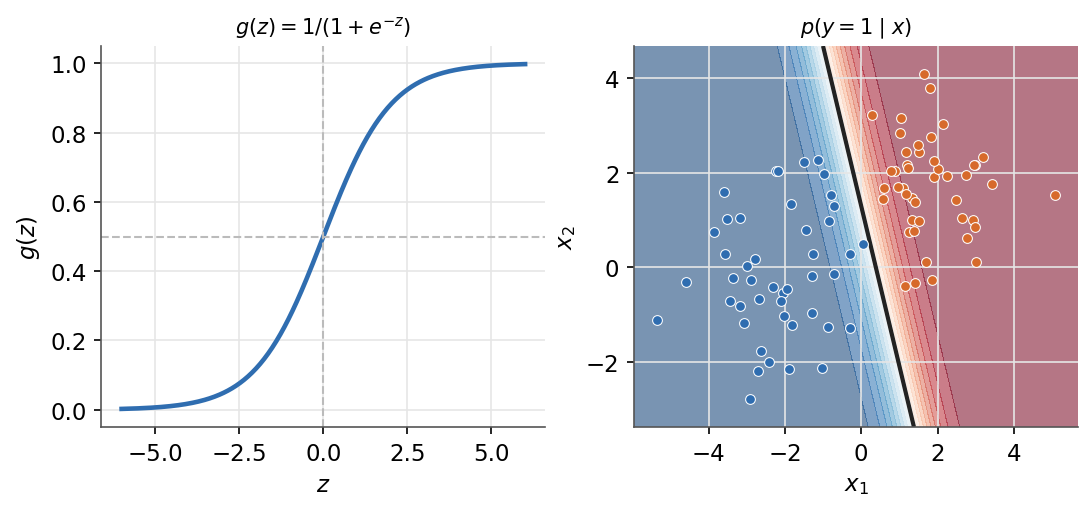
*Left: the sigmoid maps any score into the interval (0, 1). Right: the decision boundary and the predicted probability.*
168
6b31d5 lugonthier 2026-07-15 12:37:13
feat: Update "Decision trees and ensemble methods" module with new content and visuals - Revamped the introduction to ensemble methods, emphasizing the benefits of combining models. - Expanded sections on decision trees, bagging, and boosting, including detailed explanations and formulas. - Added new SVG diagrams illustrating the bagging process, the transition from stumps to trees, and variance reduction. - Introduced new images for AdaBoost rounds and variance reduction to enhance understanding.
169
### 5.4.4 Multiclass: the softmax
170
171
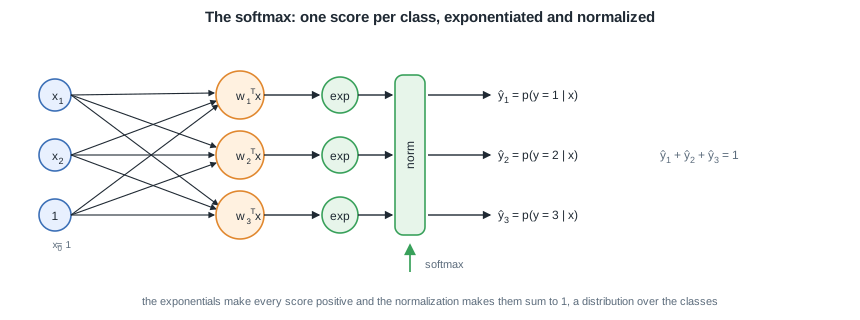
For $k$ classes the sigmoid generalizes to the softmax: one weight vector $w_c$, hence one score, per class, exponentials that make the scores positive, and a normalization that turns them into a distribution. Writing $\hat{y}_c$ for the predicted probability of class $c$, as $\hat{y}$ was the probability of the positive class above:
172
173
$$\boxed{ \hat{y}_c = p(y = c \mid x; w) = \frac{\exp(w_c^T x)}{\sum_{j=1}^{k}\exp(w_j^T x)} }$$
0ad9b6 lugonthier 2026-07-10 12:03:30
Remove "07 Regularization and high-dimensional inference" chapter and add "07 Support Vector Machines" and "08 Decision trees and ensemble methods" chapters with corresponding images.
174
6b31d5 lugonthier 2026-07-15 12:37:13
feat: Update "Decision trees and ensemble methods" module with new content and visuals - Revamped the introduction to ensemble methods, emphasizing the benefits of combining models. - Expanded sections on decision trees, bagging, and boosting, including detailed explanations and formulas. - Added new SVG diagrams illustrating the bagging process, the transition from stumps to trees, and variance reduction. - Introduced new images for AdaBoost rounds and variance reduction to enhance understanding.
175
![Multiclass logistic regression as a network](/en/Machine%20Learning/05%20Linear%20classification/a/softmax-neuron.svg)
0ad9b6 lugonthier 2026-07-10 12:03:30
Remove "07 Regularization and high-dimensional inference" chapter and add "07 Support Vector Machines" and "08 Decision trees and ensemble methods" chapters with corresponding images.
176
6b31d5 lugonthier 2026-07-15 12:37:13
feat: Update "Decision trees and ensemble methods" module with new content and visuals - Revamped the introduction to ensemble methods, emphasizing the benefits of combining models. - Expanded sections on decision trees, bagging, and boosting, including detailed explanations and formulas. - Added new SVG diagrams illustrating the bagging process, the transition from stumps to trees, and variance reduction. - Introduced new images for AdaBoost rounds and variance reduction to enhance understanding.
177
*The multiclass network with a softmax head: each class scores the input, the exponentials make the scores positive, and the normalization turns them into probabilities that sum to 1. It is the multiclass perceptron's network with the argmax replaced by a smooth, differentiable head.*
0ad9b6 lugonthier 2026-07-10 12:03:30
Remove "07 Regularization and high-dimensional inference" chapter and add "07 Support Vector Machines" and "08 Decision trees and ensemble methods" chapters with corresponding images.
178
179
With one-hot labels the loss is the categorical cross-entropy $L = -\sum_i \log p(y^{(i)} \mid x^{(i)})$, whose gradient keeps the same residual-times-input form.
180
181
| | sigmoid | softmax |
182
| --- | --- | --- |
183
| classes | 2 | $k$ |
6b31d5 lugonthier 2026-07-15 12:37:13
feat: Update "Decision trees and ensemble methods" module with new content and visuals - Revamped the introduction to ensemble methods, emphasizing the benefits of combining models. - Expanded sections on decision trees, bagging, and boosting, including detailed explanations and formulas. - Added new SVG diagrams illustrating the bagging process, the transition from stumps to trees, and variance reduction. - Introduced new images for AdaBoost rounds and variance reduction to enhance understanding.
184
| output | one probability $\hat{y}$ | a distribution over $k$ classes |
0ad9b6 lugonthier 2026-07-10 12:03:30
Remove "07 Regularization and high-dimensional inference" chapter and add "07 Support Vector Machines" and "08 Decision trees and ensemble methods" chapters with corresponding images.
185
| relation | the $k = 2$ softmax reduces to the sigmoid | generalizes the sigmoid |
186
6b31d5 lugonthier 2026-07-15 12:37:13
feat: Update "Decision trees and ensemble methods" module with new content and visuals - Revamped the introduction to ensemble methods, emphasizing the benefits of combining models. - Expanded sections on decision trees, bagging, and boosting, including detailed explanations and formulas. - Added new SVG diagrams illustrating the bagging process, the transition from stumps to trees, and variance reduction. - Introduced new images for AdaBoost rounds and variance reduction to enhance understanding.
187
<details class="proof">
188
<summary>Proof: the softmax at k = 2 is the sigmoid</summary>
189
190
With two classes the softmax scores the input twice, $w_1$ for the positive class and $w_0$ for the negative one:
191
192
$$p(y = 1 \mid x; w) = \frac{e^{w_1^T x}}{e^{w_1^T x} + e^{w_0^T x}}$$
0ad9b6 lugonthier 2026-07-10 12:03:30
Remove "07 Regularization and high-dimensional inference" chapter and add "07 Support Vector Machines" and "08 Decision trees and ensemble methods" chapters with corresponding images.
193
6b31d5 lugonthier 2026-07-15 12:37:13
feat: Update "Decision trees and ensemble methods" module with new content and visuals - Revamped the introduction to ensemble methods, emphasizing the benefits of combining models. - Expanded sections on decision trees, bagging, and boosting, including detailed explanations and formulas. - Added new SVG diagrams illustrating the bagging process, the transition from stumps to trees, and variance reduction. - Introduced new images for AdaBoost rounds and variance reduction to enhance understanding.
194
Dividing numerator and denominator by $e^{w_1^T x}$ leaves
0ad9b6 lugonthier 2026-07-10 12:03:30
Remove "07 Regularization and high-dimensional inference" chapter and add "07 Support Vector Machines" and "08 Decision trees and ensemble methods" chapters with corresponding images.
195
6b31d5 lugonthier 2026-07-15 12:37:13
feat: Update "Decision trees and ensemble methods" module with new content and visuals - Revamped the introduction to ensemble methods, emphasizing the benefits of combining models. - Expanded sections on decision trees, bagging, and boosting, including detailed explanations and formulas. - Added new SVG diagrams illustrating the bagging process, the transition from stumps to trees, and variance reduction. - Introduced new images for AdaBoost rounds and variance reduction to enhance understanding.
196
$$p(y = 1 \mid x; w) = \frac{1}{1 + e^{-(w_1 - w_0)^T x}} = \sigma\!\left((w_1 - w_0)^T x\right)$$
0ad9b6 lugonthier 2026-07-10 12:03:30
Remove "07 Regularization and high-dimensional inference" chapter and add "07 Support Vector Machines" and "08 Decision trees and ensemble methods" chapters with corresponding images.
197
6b31d5 lugonthier 2026-07-15 12:37:13
feat: Update "Decision trees and ensemble methods" module with new content and visuals - Revamped the introduction to ensemble methods, emphasizing the benefits of combining models. - Expanded sections on decision trees, bagging, and boosting, including detailed explanations and formulas. - Added new SVG diagrams illustrating the bagging process, the transition from stumps to trees, and variance reduction. - Introduced new images for AdaBoost rounds and variance reduction to enhance understanding.
198
the sigmoid applied to the difference of the scores. Only the difference $w = w_1 - w_0$ matters (the general fact behind this: shifting every $w_c$ by the same vector leaves the softmax unchanged), so a single weight vector suffices, exactly the binary model this section started from. Read in the other direction, this is the recipe for the generalization: give each class its own score $w_c^T x$, exponentiate to make the scores positive, normalize so they sum to one, and the two-class case collapses back to one sigmoid. $\blacksquare$
199
200
</details>
201
202
## 5.5 Regularized classification
203
204
Nothing pins down the scale of $w$: doubling it moves no perceptron boundary and only sharpens the probabilities of logistic regression, and different weight vectors can produce identical scores. The maximum a posteriori recipe of [Linear regression](/en/Machine%20Learning/04%20Linear%20regression) applies verbatim, adding a penalty to whichever loss is being minimized:
205
206
$$\boxed{ J_\lambda(w) = \sum_{i=1}^{m} L\!\left(h_w(x^{(i)}),\,y^{(i)}\right) + \lambda\,\Omega(w), \qquad \Omega(w) = \lVert w \rVert_2^2 \ \text{or} \ \lVert w \rVert_1 }$$
207
208
For the cross-entropy with the L2 penalty, the gradient simply gains a pull toward zero, $\sum_i (\hat{y}^{(i)} - y^{(i)})\,x^{(i)} + 2\lambda w$.
0ad9b6 lugonthier 2026-07-10 12:03:30
Remove "07 Regularization and high-dimensional inference" chapter and add "07 Support Vector Machines" and "08 Decision trees and ensemble methods" chapters with corresponding images.
209
210
*Remark:* libraries expose exactly this menu, a loss plus a penalty (scikit-learn's `SGDClassifier` takes a `loss` and a `penalty` argument). The strength $\lambda$ is chosen by the validation of [General concepts](/en/Machine%20Learning/02%20General%20concepts), and the lasso's selecting behaviour is covered in [Linear regression](/en/Machine%20Learning/04%20Linear%20regression).
211
6b31d5 lugonthier 2026-07-15 12:37:13
feat: Update "Decision trees and ensemble methods" module with new content and visuals - Revamped the introduction to ensemble methods, emphasizing the benefits of combining models. - Expanded sections on decision trees, bagging, and boosting, including detailed explanations and formulas. - Added new SVG diagrams illustrating the bagging process, the transition from stumps to trees, and variance reduction. - Introduced new images for AdaBoost rounds and variance reduction to enhance understanding.
212
## 5.6 Summary
0ad9b6 lugonthier 2026-07-10 12:03:30
Remove "07 Regularization and high-dimensional inference" chapter and add "07 Support Vector Machines" and "08 Decision trees and ensemble methods" chapters with corresponding images.
213
6b31d5 lugonthier 2026-07-15 12:37:13
feat: Update "Decision trees and ensemble methods" module with new content and visuals - Revamped the introduction to ensemble methods, emphasizing the benefits of combining models. - Expanded sections on decision trees, bagging, and boosting, including detailed explanations and formulas. - Added new SVG diagrams illustrating the bagging process, the transition from stumps to trees, and variance reduction. - Introduced new images for AdaBoost rounds and variance reduction to enhance understanding.
214
The classical methods all fit the same hyperplane, and they split cleanly by what they assume about the data and how they are solved: least squares inherits the closed-form comfort of [Linear regression](/en/Machine%20Learning/04%20Linear%20regression) and pays for it with a distributional assumption, the perceptron and logistic regression assume nothing and pay with iterative optimization. Algorithm by algorithm, the formulas that define each one:
0ad9b6 lugonthier 2026-07-10 12:03:30
Remove "07 Regularization and high-dimensional inference" chapter and add "07 Support Vector Machines" and "08 Decision trees and ensemble methods" chapters with corresponding images.
215
6b31d5 lugonthier 2026-07-15 12:37:13
feat: Update "Decision trees and ensemble methods" module with new content and visuals - Revamped the introduction to ensemble methods, emphasizing the benefits of combining models. - Expanded sections on decision trees, bagging, and boosting, including detailed explanations and formulas. - Added new SVG diagrams illustrating the bagging process, the transition from stumps to trees, and variance reduction. - Introduced new images for AdaBoost rounds and variance reduction to enhance understanding.
216
**Least squares**, the one with an assumption and a closed form:
0ad9b6 lugonthier 2026-07-10 12:03:30
Remove "07 Regularization and high-dimensional inference" chapter and add "07 Support Vector Machines" and "08 Decision trees and ensemble methods" chapters with corresponding images.
217
6b31d5 lugonthier 2026-07-15 12:37:13
feat: Update "Decision trees and ensemble methods" module with new content and visuals - Revamped the introduction to ensemble methods, emphasizing the benefits of combining models. - Expanded sections on decision trees, bagging, and boosting, including detailed explanations and formulas. - Added new SVG diagrams illustrating the bagging process, the transition from stumps to trees, and variance reduction. - Introduced new images for AdaBoost rounds and variance reduction to enhance understanding.
218
| | Formula |
219
| --- | --- |
220
| Assumption on the data | Gaussian-shaped classes |
221
| Activation | identity to train (regression on $\pm 1$ targets), then $\mathrm{sign}(w^T x)$ to predict |
222
| Loss | squared error $\sum_{i=1}^{m}\left(w^T x^{(i)} - y^{(i)}\right)^2$ |
223
| Fit | closed form $w = (X^T X)^{-1}X^T y$, no iteration |
224
| Multiclass | one-hot rows of $Y$, $W = (X^T X)^{-1}X^T Y$, predict $\arg\max_k\,(W^T x)_k$ |
0ad9b6 lugonthier 2026-07-10 12:03:30
Remove "07 Regularization and high-dimensional inference" chapter and add "07 Support Vector Machines" and "08 Decision trees and ensemble methods" chapters with corresponding images.
225
6b31d5 lugonthier 2026-07-15 12:37:13
feat: Update "Decision trees and ensemble methods" module with new content and visuals - Revamped the introduction to ensemble methods, emphasizing the benefits of combining models. - Expanded sections on decision trees, bagging, and boosting, including detailed explanations and formulas. - Added new SVG diagrams illustrating the bagging process, the transition from stumps to trees, and variance reduction. - Introduced new images for AdaBoost rounds and variance reduction to enhance understanding.
226
**The perceptron**, mistake-driven and assumption-free:
0ad9b6 lugonthier 2026-07-10 12:03:30
Remove "07 Regularization and high-dimensional inference" chapter and add "07 Support Vector Machines" and "08 Decision trees and ensemble methods" chapters with corresponding images.
227
6b31d5 lugonthier 2026-07-15 12:37:13
feat: Update "Decision trees and ensemble methods" module with new content and visuals - Revamped the introduction to ensemble methods, emphasizing the benefits of combining models. - Expanded sections on decision trees, bagging, and boosting, including detailed explanations and formulas. - Added new SVG diagrams illustrating the bagging process, the transition from stumps to trees, and variance reduction. - Introduced new images for AdaBoost rounds and variance reduction to enhance understanding.
228
| | Formula |
229
| --- | --- |
230
| Assumption on the data | none |
231
| Activation | step, $h_w(x) = \mathrm{sign}(w^T x)$, $y \in \{-1, +1\}$ |
232
| Loss | perceptron criterion $E(w) = -\sum_{i \in \mathcal{M}} y^{(i)}\, w^T x^{(i)}$, misclassified points only |
233
| Gradient | $\nabla_w E = -\sum_{i \in \mathcal{M}} y^{(i)} x^{(i)}$ |
234
| Update | $w \leftarrow w + \alpha\, y^{(i)} x^{(i)}$ on a mistake, nothing otherwise |
235
| Multiclass | $\hat{y} = \arg\max_c\, w_c^T x$, then $w_{y} \mathrel{+}= \alpha x$ and $w_{\hat{y}} \mathrel{-}= \alpha x$ |
236
| Convergence | finite if the data is separable, oscillates otherwise |
237
238
**Logistic regression**, probabilistic and assumption-free:
239
240
| | Formula |
241
| --- | --- |
242
| Assumption on the data | none |
243
| Activation | sigmoid, $\hat{y} = \sigma(w^T x) = \tfrac{1}{1 + e^{-w^T x}}$, a probability, $y \in \{0, 1\}$ |
244
| Loss | cross-entropy $L(w) = -\sum_{i=1}^{m}\left[ y^{(i)}\log \hat{y}^{(i)} + (1 - y^{(i)})\log(1 - \hat{y}^{(i)}) \right]$ |
245
| Gradient | $\nabla_{w_j} L = \sum_{i=1}^{m}\left(\hat{y}^{(i)} - y^{(i)}\right)x_j^{(i)}$, every point pulls by its residual |
246
| Update | $w_j \leftarrow w_j - \alpha \sum_{i=1}^{m}\left(\hat{y}^{(i)} - y^{(i)}\right)x_j^{(i)}$ |
247
| Multiclass | softmax $\hat{y}_c = \tfrac{\exp(w_c^T x)}{\sum_{j}\exp(w_j^T x)}$ and the categorical cross-entropy |
248
81a3ca lugonthier 2026-07-28 13:29:31
slide 01
249
*Remark:* read side by side, the perceptron update (in its $\{0, 1\}$ coding) and the logistic update are the same formula, the residual times the input, and only the activation changes (the step for the perceptron, the sigmoid for logistic regression, and the identity of linear regression completes the family). The Deep Learning course picks up exactly this thread, stacking such units into layers.
0ad9b6 lugonthier 2026-07-10 12:03:30
Remove "07 Regularization and high-dimensional inference" chapter and add "07 Support Vector Machines" and "08 Decision trees and ensemble methods" chapters with corresponding images.
250
251
*With linear models covered, the next module stacks these building blocks into multilayer neural networks.*
252
253
---
254
Next: [Multilayer neural networks](/en/Machine%20Learning/06%20Multilayer%20neural%20networks) · [Course overview](/en/Machine%20Learning)