Blame

12d21f lugonthier 2026-07-24 11:49:19
Remove unused SVG files and update Markdown content for clarity and accuracy in MLOps and Machine Learning modules. Adjust references to optimization techniques and activation functions, and enhance explanations in the mathematical refresher section.
1
# 7. Recurrent networks
36084c lugonthier 2026-07-02 14:39:19
Add new content and images for Linear Models, Regularization, SVMs, and Decision Trees - Added images for linear regression, logistic regression, and perceptron. - Introduced a new section on Regularization and High-Dimensional Inference with detailed explanations and images. - Added content on Support Vector Machines, including definitions, loss functions, and kernel methods. - Created a new section on Decision Trees and Ensemble Methods, covering CART, bagging, random forests, and boosting. - Included relevant images to illustrate concepts in Decision Trees and Ensemble Methods.
2
3
Feedforward and convolutional networks map a fixed-size input to an output in one pass, but many problems come as sequences whose length varies and whose order matters (text, audio, time series). A recurrent neural network (RNN) processes a sequence one step at a time and carries a hidden state forward, so past inputs influence the current output. This module introduces recurrence, the vanilla RNN cell, how it is trained by backpropagation through time, and why long-range gradients tend to vanish or explode.
4
12d21f lugonthier 2026-07-24 11:49:19
Remove unused SVG files and update Markdown content for clarity and accuracy in MLOps and Machine Learning modules. Adjust references to optimization techniques and activation functions, and enhance explanations in the mathematical refresher section.
5
## 7.1 Why not an MLP or a CNN?
36084c lugonthier 2026-07-02 14:39:19
Add new content and images for Linear Models, Regularization, SVMs, and Decision Trees - Added images for linear regression, logistic regression, and perceptron. - Introduced a new section on Regularization and High-Dimensional Inference with detailed explanations and images. - Added content on Support Vector Machines, including definitions, loss functions, and kernel methods. - Created a new section on Decision Trees and Ensemble Methods, covering CART, bagging, random forests, and boosting. - Included relevant images to illustrate concepts in Decision Trees and Ensemble Methods.
6
12d21f lugonthier 2026-07-24 11:49:19
Remove unused SVG files and update Markdown content for clarity and accuracy in MLOps and Machine Learning modules. Adjust references to optimization techniques and activation functions, and enhance explanations in the mathematical refresher section.
7
A sequence is an ordered list of inputs $x_1, x_2, \dots, x_T$: the words of a review, the samples of an audio clip, the daily values of a time series. Two things make it awkward for the networks we already have. The length $T$ changes from one example to the next, and the order carries the meaning: "not good, actually great" and "not great, actually good" contain exactly the same words.
36084c lugonthier 2026-07-02 14:39:19
Add new content and images for Linear Models, Regularization, SVMs, and Decision Trees - Added images for linear regression, logistic regression, and perceptron. - Introduced a new section on Regularization and High-Dimensional Inference with detailed explanations and images. - Added content on Support Vector Machines, including definitions, loss functions, and kernel methods. - Created a new section on Decision Trees and Ensemble Methods, covering CART, bagging, random forests, and boosting. - Included relevant images to illustrate concepts in Decision Trees and Ensemble Methods.
8
12d21f lugonthier 2026-07-24 11:49:19
Remove unused SVG files and update Markdown content for clarity and accuracy in MLOps and Machine Learning modules. Adjust references to optimization techniques and activation functions, and enhance explanations in the mathematical refresher section.
9
Try the tools already on the table:
36084c lugonthier 2026-07-02 14:39:19
Add new content and images for Linear Models, Regularization, SVMs, and Decision Trees - Added images for linear regression, logistic regression, and perceptron. - Introduced a new section on Regularization and High-Dimensional Inference with detailed explanations and images. - Added content on Support Vector Machines, including definitions, loss functions, and kernel methods. - Created a new section on Decision Trees and Ensemble Methods, covering CART, bagging, random forests, and boosting. - Included relevant images to illustrate concepts in Decision Trees and Ensemble Methods.
10
12d21f lugonthier 2026-07-24 11:49:19
Remove unused SVG files and update Markdown content for clarity and accuracy in MLOps and Machine Learning modules. Adjust references to optimization techniques and activation functions, and enhance explanations in the mathematical refresher section.
11
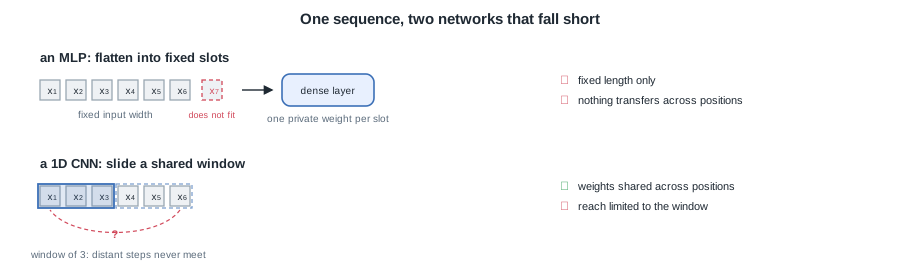
- **An MLP** expects one fixed-size vector $a^{[0]} = x$, so a longer sequence simply does not fit its input layer. Worse, each position gets its own private weights: a pattern learned on the 2nd word teaches nothing about the same pattern on the 9th, the dense-layer problem of lesson 5 all over again, in time instead of space.
12
- **A 1D CNN** fixes the sharing: one kernel slides along the sequence, the same weights at every position. But its window is $k$ steps wide, so two inputs only ever meet if they fall inside the same receptive field. The end of a long sequence cannot see its beginning without stacking many layers, and the reach is still fixed at build time.
36084c lugonthier 2026-07-02 14:39:19
Add new content and images for Linear Models, Regularization, SVMs, and Decision Trees - Added images for linear regression, logistic regression, and perceptron. - Introduced a new section on Regularization and High-Dimensional Inference with detailed explanations and images. - Added content on Support Vector Machines, including definitions, loss functions, and kernel methods. - Created a new section on Decision Trees and Ensemble Methods, covering CART, bagging, random forests, and boosting. - Included relevant images to illustrate concepts in Decision Trees and Ensemble Methods.
13
12d21f lugonthier 2026-07-24 11:49:19
Remove unused SVG files and update Markdown content for clarity and accuracy in MLOps and Machine Learning modules. Adjust references to optimization techniques and activation functions, and enhance explanations in the mathematical refresher section.
14
What sequences call for is three things at once: accept any length, apply the same weights at every step, and carry a memory of what has been seen so far, however far back.
15
16
![The same sequence fed to an MLP and to a 1D CNN](/en/Deep%20Learning/07%20Recurrent%20networks/a/rnn-motivation.svg)
17
18
*The same six-step sequence, twice. The MLP has fixed slots and private weights per position. The 1D convolution shares its weights, but only relates inputs that fall inside its window.*
19
20
Whatever meets all three requirements at once will be the subject of this lesson. Before building it, note the shapes sequence tasks come in:
36084c lugonthier 2026-07-02 14:39:19
Add new content and images for Linear Models, Regularization, SVMs, and Decision Trees - Added images for linear regression, logistic regression, and perceptron. - Introduced a new section on Regularization and High-Dimensional Inference with detailed explanations and images. - Added content on Support Vector Machines, including definitions, loss functions, and kernel methods. - Created a new section on Decision Trees and Ensemble Methods, covering CART, bagging, random forests, and boosting. - Included relevant images to illustrate concepts in Decision Trees and Ensemble Methods.
21
22
| Setup | Input | Output | Example |
23
| --- | --- | --- | --- |
24
| Many to one | sequence | single vector | sentiment of a sentence |
25
| Many to many (aligned) | sequence | sequence, same length | part-of-speech tagging |
26
| Many to many (seq2seq) | sequence | sequence, other length | machine translation |
27
| One to many | single vector | sequence | image captioning |
28
12d21f lugonthier 2026-07-24 11:49:19
Remove unused SVG files and update Markdown content for clarity and accuracy in MLOps and Machine Learning modules. Adjust references to optimization techniques and activation functions, and enhance explanations in the mathematical refresher section.
29
## 7.2 The vanilla RNN cell
30
31
The recurrent network meets all three requirements with one move. It keeps a **hidden state** (or memory) $h_t$ that summarizes everything relevant seen up to step $t$, and it **shares** one set of parameters across every step, so the same transformation applies whether the sequence has 5 elements or 500. Sharing keeps the parameter count independent of $T$ and lets a pattern learned at one position generalize to any other.
32
33
*Remark:* weight sharing across time is the sequential analogue of weight sharing across space in a convolutional network. Both encode a prior that the same feature can appear anywhere.
36084c lugonthier 2026-07-02 14:39:19
Add new content and images for Linear Models, Regularization, SVMs, and Decision Trees - Added images for linear regression, logistic regression, and perceptron. - Introduced a new section on Regularization and High-Dimensional Inference with detailed explanations and images. - Added content on Support Vector Machines, including definitions, loss functions, and kernel methods. - Created a new section on Decision Trees and Ensemble Methods, covering CART, bagging, random forests, and boosting. - Included relevant images to illustrate concepts in Decision Trees and Ensemble Methods.
34
12d21f lugonthier 2026-07-24 11:49:19
Remove unused SVG files and update Markdown content for clarity and accuracy in MLOps and Machine Learning modules. Adjust references to optimization techniques and activation functions, and enhance explanations in the mathematical refresher section.
35
### 7.2.1 Recurrence
36084c lugonthier 2026-07-02 14:39:19
Add new content and images for Linear Models, Regularization, SVMs, and Decision Trees - Added images for linear regression, logistic regression, and perceptron. - Introduced a new section on Regularization and High-Dimensional Inference with detailed explanations and images. - Added content on Support Vector Machines, including definitions, loss functions, and kernel methods. - Created a new section on Decision Trees and Ensemble Methods, covering CART, bagging, random forests, and boosting. - Included relevant images to illustrate concepts in Decision Trees and Ensemble Methods.
36
37
At step $t$ the cell reads the current input $x_t$ and the previous hidden state $h_{t-1}$, then produces a new hidden state through an activation $g$ (usually $\tanh$):
38
39
$$\boxed{ h_t = g\left(W_{hh}\, h_{t-1} + W_{xh}\, x_t + b_h\right) }$$
40
41
The hidden state is initialized to $h_0 = \mathbf{0}$ (or a learned vector). The per-step output is a linear readout of the hidden state:
42
43
$$\boxed{ \hat{y}_t = W_{hy}\, h_t + b_y }$$
44
45
Here $W_{hh}$ maps state to state, $W_{xh}$ maps input to state, and $W_{hy}$ maps state to output. If the hidden size is $n_h$ and the input size is $n_x$, then $W_{hh}$ is $(n_h \times n_h)$, $W_{xh}$ is $(n_h \times n_x)$, and $b_h$ has shape $n_h$.
46
6b31d5 lugonthier 2026-07-15 12:37:13
feat: Update "Decision trees and ensemble methods" module with new content and visuals - Revamped the introduction to ensemble methods, emphasizing the benefits of combining models. - Expanded sections on decision trees, bagging, and boosting, including detailed explanations and formulas. - Added new SVG diagrams illustrating the bagging process, the transition from stumps to trees, and variance reduction. - Introduced new images for AdaBoost rounds and variance reduction to enhance understanding.
47
*Remark:* this keeps the explicit-bias convention of the whole Deep Learning course. The bias $b_h$ is a separate additive term, never folded into the weight matrices the way the Machine Learning course folded the intercept into $w^T x$ with $x_0 = 1$.
36084c lugonthier 2026-07-02 14:39:19
Add new content and images for Linear Models, Regularization, SVMs, and Decision Trees - Added images for linear regression, logistic regression, and perceptron. - Introduced a new section on Regularization and High-Dimensional Inference with detailed explanations and images. - Added content on Support Vector Machines, including definitions, loss functions, and kernel methods. - Created a new section on Decision Trees and Ensemble Methods, covering CART, bagging, random forests, and boosting. - Included relevant images to illustrate concepts in Decision Trees and Ensemble Methods.
48
12d21f lugonthier 2026-07-24 11:49:19
Remove unused SVG files and update Markdown content for clarity and accuracy in MLOps and Machine Learning modules. Adjust references to optimization techniques and activation functions, and enhance explanations in the mathematical refresher section.
49
### 7.2.2 Shared weights
36084c lugonthier 2026-07-02 14:39:19
Add new content and images for Linear Models, Regularization, SVMs, and Decision Trees - Added images for linear regression, logistic regression, and perceptron. - Introduced a new section on Regularization and High-Dimensional Inference with detailed explanations and images. - Added content on Support Vector Machines, including definitions, loss functions, and kernel methods. - Created a new section on Decision Trees and Ensemble Methods, covering CART, bagging, random forests, and boosting. - Included relevant images to illustrate concepts in Decision Trees and Ensemble Methods.
50
51
The crucial point is that $W_{hh}$, $W_{xh}$, $W_{hy}$, $b_h$, and $b_y$ do **not** depend on $t$. The same five parameters are reused at every step:
52
6b31d5 lugonthier 2026-07-15 12:37:13
feat: Update "Decision trees and ensemble methods" module with new content and visuals - Revamped the introduction to ensemble methods, emphasizing the benefits of combining models. - Expanded sections on decision trees, bagging, and boosting, including detailed explanations and formulas. - Added new SVG diagrams illustrating the bagging process, the transition from stumps to trees, and variance reduction. - Introduced new images for AdaBoost rounds and variance reduction to enhance understanding.
53
$$\boxed{ w = \{W_{hh},\, W_{xh},\, W_{hy},\, b_h,\, b_y\} \quad \text{used at every step } t }$$
36084c lugonthier 2026-07-02 14:39:19
Add new content and images for Linear Models, Regularization, SVMs, and Decision Trees - Added images for linear regression, logistic regression, and perceptron. - Introduced a new section on Regularization and High-Dimensional Inference with detailed explanations and images. - Added content on Support Vector Machines, including definitions, loss functions, and kernel methods. - Created a new section on Decision Trees and Ensemble Methods, covering CART, bagging, random forests, and boosting. - Included relevant images to illustrate concepts in Decision Trees and Ensemble Methods.
54
55
So an RNN is not a very deep network with distinct layers, it is one small cell applied repeatedly, feeding its own output back as input.
56
12d21f lugonthier 2026-07-24 11:49:19
Remove unused SVG files and update Markdown content for clarity and accuracy in MLOps and Machine Learning modules. Adjust references to optimization techniques and activation functions, and enhance explanations in the mathematical refresher section.
57
## 7.3 Unrolling in time
36084c lugonthier 2026-07-02 14:39:19
Add new content and images for Linear Models, Regularization, SVMs, and Decision Trees - Added images for linear regression, logistic regression, and perceptron. - Introduced a new section on Regularization and High-Dimensional Inference with detailed explanations and images. - Added content on Support Vector Machines, including definitions, loss functions, and kernel methods. - Created a new section on Decision Trees and Ensemble Methods, covering CART, bagging, random forests, and boosting. - Included relevant images to illustrate concepts in Decision Trees and Ensemble Methods.
58
59
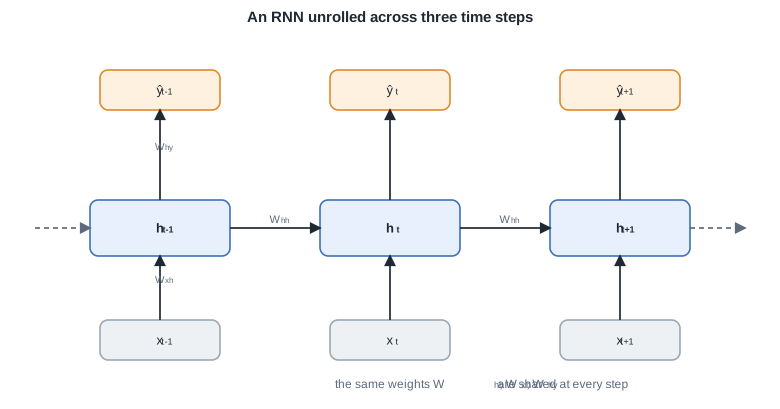
Because the same cell is reused, we can **unroll** the recurrence into a chain: draw one copy of the cell per time step and connect the hidden state of each copy to the next. The unrolled view is an ordinary feedforward graph (with tied weights), which is exactly what makes gradient computation possible.
60
12d21f lugonthier 2026-07-24 11:49:19
Remove unused SVG files and update Markdown content for clarity and accuracy in MLOps and Machine Learning modules. Adjust references to optimization techniques and activation functions, and enhance explanations in the mathematical refresher section.
61
![RNN unrolled across three time steps](/en/Deep%20Learning/07%20Recurrent%20networks/a/rnn-unrolled.svg)
36084c lugonthier 2026-07-02 14:39:19
Add new content and images for Linear Models, Regularization, SVMs, and Decision Trees - Added images for linear regression, logistic regression, and perceptron. - Introduced a new section on Regularization and High-Dimensional Inference with detailed explanations and images. - Added content on Support Vector Machines, including definitions, loss functions, and kernel methods. - Created a new section on Decision Trees and Ensemble Methods, covering CART, bagging, random forests, and boosting. - Included relevant images to illustrate concepts in Decision Trees and Ensemble Methods.
62
63
*Unrolled in time, a recurrent network reuses the same weights at every step and passes the hidden state forward.*
64
65
*Remark:* the horizontal arrows between hidden states are the only path along which information from the past reaches the present. Every one of them multiplies by the same matrix $W_{hh}$, which is the source of both the model's power and its training difficulty.
66
12d21f lugonthier 2026-07-24 11:49:19
Remove unused SVG files and update Markdown content for clarity and accuracy in MLOps and Machine Learning modules. Adjust references to optimization techniques and activation functions, and enhance explanations in the mathematical refresher section.
67
## 7.4 Backpropagation through time
36084c lugonthier 2026-07-02 14:39:19
Add new content and images for Linear Models, Regularization, SVMs, and Decision Trees - Added images for linear regression, logistic regression, and perceptron. - Introduced a new section on Regularization and High-Dimensional Inference with detailed explanations and images. - Added content on Support Vector Machines, including definitions, loss functions, and kernel methods. - Created a new section on Decision Trees and Ensemble Methods, covering CART, bagging, random forests, and boosting. - Included relevant images to illustrate concepts in Decision Trees and Ensemble Methods.
68
69
Training minimizes a total cost that sums the per-step loss over the sequence. With per-step loss $L_t$ comparing $\hat{y}_t$ to the target $y_t$, the cost for one sequence is:
70
71
$$\boxed{ J = \sum_{t=1}^{T} L_t\left(\hat{y}_t, y_t\right) }$$
72
73
Backpropagation through time (BPTT) is ordinary backpropagation run on the unrolled graph. Because $W_{hh}$ is reused at every step, its gradient is the **sum** of the contributions from all steps:
74
75
$$\boxed{ \frac{\partial J}{\partial W_{hh}} = \sum_{t=1}^{T} \frac{\partial L_t}{\partial W_{hh}} }$$
76
77
For a single step $t$, the loss depends on $W_{hh}$ both directly (through $h_t$) and indirectly through every earlier hidden state $h_k$ with $k \le t$, since each of those was itself produced with $W_{hh}$. Applying the chain rule through the state chain gives:
78
79
$$\boxed{ \frac{\partial L_t}{\partial W_{hh}} = \sum_{k=1}^{t} \frac{\partial L_t}{\partial h_t}\left(\prod_{i=k+1}^{t} \frac{\partial h_i}{\partial h_{i-1}}\right)\frac{\partial h_k}{\partial W_{hh}} }$$
80
81
*Remark:* in practice the sum over $k$ is cut off after a fixed window, which is called truncated BPTT. It bounds memory and compute per update at the cost of ignoring dependencies longer than the window.
82
12d21f lugonthier 2026-07-24 11:49:19
Remove unused SVG files and update Markdown content for clarity and accuracy in MLOps and Machine Learning modules. Adjust references to optimization techniques and activation functions, and enhance explanations in the mathematical refresher section.
83
## 7.5 Vanishing and exploding gradients
36084c lugonthier 2026-07-02 14:39:19
Add new content and images for Linear Models, Regularization, SVMs, and Decision Trees - Added images for linear regression, logistic regression, and perceptron. - Introduced a new section on Regularization and High-Dimensional Inference with detailed explanations and images. - Added content on Support Vector Machines, including definitions, loss functions, and kernel methods. - Created a new section on Decision Trees and Ensemble Methods, covering CART, bagging, random forests, and boosting. - Included relevant images to illustrate concepts in Decision Trees and Ensemble Methods.
84
85
The inner product $\prod_{i=k+1}^{t} \frac{\partial h_i}{\partial h_{i-1}}$ is what carries gradient information from step $t$ back to step $k$. From the recurrence $h_i = g(W_{hh} h_{i-1} + W_{xh} x_i + b_h)$, each factor is:
86
87
$$\boxed{ \frac{\partial h_i}{\partial h_{i-1}} = \operatorname{diag}\!\left(g'(z_i)\right) W_{hh} }$$
88
89
where $z_i = W_{hh} h_{i-1} + W_{xh} x_i + b_h$ is the pre-activation at step $i$. Composing over the whole gap from $k$ to $t$ gives a product of $t - k$ such matrices:
90
91
$$\boxed{ \prod_{i=k+1}^{t} \frac{\partial h_i}{\partial h_{i-1}} = \prod_{i=k+1}^{t} \operatorname{diag}\!\left(g'(z_i)\right) W_{hh} }$$
92
93
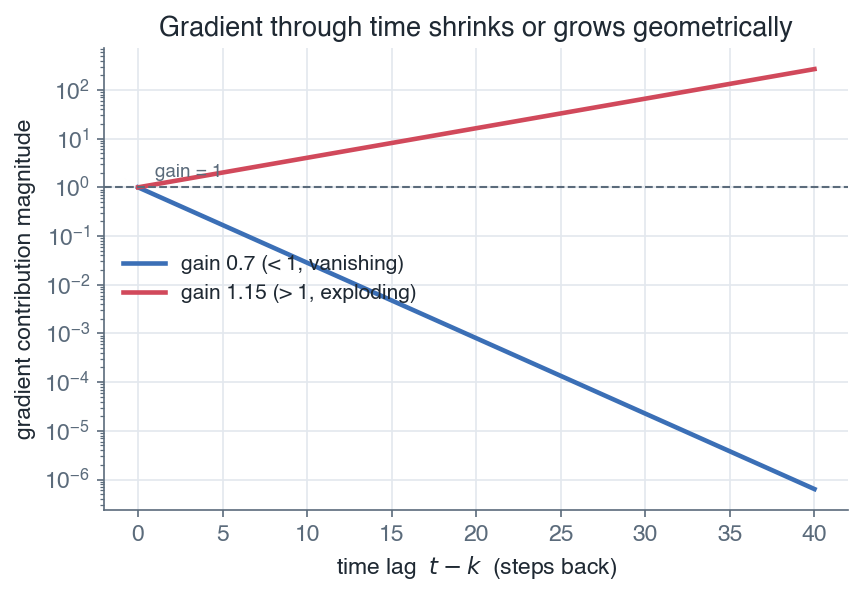
This product of $t - k$ near-identical factors behaves roughly like a matrix raised to the power $t - k$. If the relevant magnitude (informally, the largest singular value of $\operatorname{diag}(g'(z_i)) W_{hh}$) is below $1$, the product shrinks geometrically toward zero as the gap grows, so distant gradients **vanish**. If it is above $1$, the product blows up and gradients **explode**.
94
12d21f lugonthier 2026-07-24 11:49:19
Remove unused SVG files and update Markdown content for clarity and accuracy in MLOps and Machine Learning modules. Adjust references to optimization techniques and activation functions, and enhance explanations in the mathematical refresher section.
95
![Gradient magnitude versus time lag on a log scale](/en/Deep%20Learning/07%20Recurrent%20networks/a/bptt-decay.png)
36084c lugonthier 2026-07-02 14:39:19
Add new content and images for Linear Models, Regularization, SVMs, and Decision Trees - Added images for linear regression, logistic regression, and perceptron. - Introduced a new section on Regularization and High-Dimensional Inference with detailed explanations and images. - Added content on Support Vector Machines, including definitions, loss functions, and kernel methods. - Created a new section on Decision Trees and Ensemble Methods, covering CART, bagging, random forests, and boosting. - Included relevant images to illustrate concepts in Decision Trees and Ensemble Methods.
96
97
*Through many time steps the gradient shrinks or grows geometrically, so long-range dependencies are hard for a plain RNN to learn.*
98
99
| Regime | Product over time | Effect on training |
100
| --- | --- | --- |
101
| Factor magnitude $< 1$ | decays toward $0$ | long-range gradients vanish, no long memory learned |
102
| Factor magnitude $\approx 1$ | stays bounded | stable, the ideal case |
103
| Factor magnitude $> 1$ | grows without bound | gradients explode, updates diverge |
104
105
*Remark:* exploding gradients are usually tamed with **gradient clipping** (rescale the gradient when its norm exceeds a threshold). Vanishing gradients are harder, because the signal is lost rather than merely large, and no simple rescaling recovers it.
106
107
Since a saturating activation such as $\tanh$ has $g' \le 1$ everywhere, the diagonal factor tends to pull the product toward vanishing, which makes it hard for a vanilla RNN to learn dependencies more than a few dozen steps apart. This limitation is precisely what motivates gated cells, which add a near-linear path for the state to flow along without repeated squashing.
108
109
*The next lesson introduces the LSTM and GRU, gated architectures that carry a cell state through additive updates so gradients can travel across long spans without vanishing.*
110
111
---
12d21f lugonthier 2026-07-24 11:49:19
Remove unused SVG files and update Markdown content for clarity and accuracy in MLOps and Machine Learning modules. Adjust references to optimization techniques and activation functions, and enhance explanations in the mathematical refresher section.
112
Next: [LSTM and GRU](/en/Deep%20Learning/08%20LSTM%20and%20GRU) · [Course overview](/en/Deep%20Learning)