Blame

12d21f lugonthier 2026-07-24 11:49:19
Remove unused SVG files and update Markdown content for clarity and accuracy in MLOps and Machine Learning modules. Adjust references to optimization techniques and activation functions, and enhance explanations in the mathematical refresher section.
1
# 2. Fonctions d'activation
36084c lugonthier 2026-07-02 14:39:19
Add new content and images for Linear Models, Regularization, SVMs, and Decision Trees - Added images for linear regression, logistic regression, and perceptron. - Introduced a new section on Regularization and High-Dimensional Inference with detailed explanations and images. - Added content on Support Vector Machines, including definitions, loss functions, and kernel methods. - Created a new section on Decision Trees and Ensemble Methods, covering CART, bagging, random forests, and boosting. - Included relevant images to illustrate concepts in Decision Trees and Ensemble Methods.
2
3
Chaque couche calcule une pré-activation $z^{[l]} = W^{[l]} a^{[l-1]} + b^{[l]}$ puis une activation $a^{[l]} = g^{[l]}(z^{[l]})$. Le choix de la non-linéarité $g^{[l]}$ est ce qui rend la profondeur utile. Cette leçon explique pourquoi une fonction $g$ non linéaire est nécessaire, passe en revue les familles sigmoïde, tanh et ReLU, présente la softmax utilisée en sortie et donne des conseils pratiques sur l'activation à choisir.
4
12d21f lugonthier 2026-07-24 11:49:19
Remove unused SVG files and update Markdown content for clarity and accuracy in MLOps and Machine Learning modules. Adjust references to optimization techniques and activation functions, and enhance explanations in the mathematical refresher section.
5
## 2.1 Pourquoi la non-linéarité est nécessaire
36084c lugonthier 2026-07-02 14:39:19
Add new content and images for Linear Models, Regularization, SVMs, and Decision Trees - Added images for linear regression, logistic regression, and perceptron. - Introduced a new section on Regularization and High-Dimensional Inference with detailed explanations and images. - Added content on Support Vector Machines, including definitions, loss functions, and kernel methods. - Created a new section on Decision Trees and Ensemble Methods, covering CART, bagging, random forests, and boosting. - Included relevant images to illustrate concepts in Decision Trees and Ensemble Methods.
6
7
Supposons que chaque activation soit l'identité, $g^{[l]}(z) = z$. Alors chaque couche se réduit à $a^{[l]} = W^{[l]} a^{[l-1]} + b^{[l]}$, et composer deux d'entre elles donne $W^{[2]}(W^{[1]} x + b^{[1]}) + b^{[2]} = (W^{[2]} W^{[1]}) x + (W^{[2]} b^{[1]} + b^{[2]})$. C'est de nouveau de la forme $W x + b$. Par récurrence, l'ensemble du réseau à $L$ couches se réduit à une seule application affine :
8
9
$$\boxed{ g^{[l]} = \text{identity} \;\Rightarrow\; \hat{y} = W' x + b' }$$
10
11
avec $W' = W^{[L]} \cdots W^{[1]}$ et $b'$ le biais accumulé. Peu importe le nombre de couches linéaires empilées, le modèle ne peut ajuster qu'une fonction linéaire, donc la profondeur supplémentaire n'apporte rien. Une fonction $g$ non linéaire entre les couches est précisément ce qui brise cet effondrement et permet au réseau de représenter des frontières de décision courbes et des régressions non linéaires.
12
6b31d5 lugonthier 2026-07-15 12:37:13
feat: Update "Decision trees and ensemble methods" module with new content and visuals - Revamped the introduction to ensemble methods, emphasizing the benefits of combining models. - Expanded sections on decision trees, bagging, and boosting, including detailed explanations and formulas. - Added new SVG diagrams illustrating the bagging process, the transition from stumps to trees, and variance reduction. - Introduced new images for AdaBoost rounds and variance reduction to enhance understanding.
13
*Remarque :* le biais est conservé ici de façon explicite sous la forme $b^{[l]}$, contrairement au cours de Machine Learning où l'ordonnée à l'origine était intégrée dans $w^T x$ via l'entrée augmentée $x_0 = 1$. Dans ce cours de Deep Learning, chaque couche possède sa propre matrice de poids $W^{[l]}$ et son propre vecteur de biais $b^{[l]}$.
36084c lugonthier 2026-07-02 14:39:19
Add new content and images for Linear Models, Regularization, SVMs, and Decision Trees - Added images for linear regression, logistic regression, and perceptron. - Introduced a new section on Regularization and High-Dimensional Inference with detailed explanations and images. - Added content on Support Vector Machines, including definitions, loss functions, and kernel methods. - Created a new section on Decision Trees and Ensemble Methods, covering CART, bagging, random forests, and boosting. - Included relevant images to illustrate concepts in Decision Trees and Ensemble Methods.
14
12d21f lugonthier 2026-07-24 11:49:19
Remove unused SVG files and update Markdown content for clarity and accuracy in MLOps and Machine Learning modules. Adjust references to optimization techniques and activation functions, and enhance explanations in the mathematical refresher section.
15
## 2.2 Sigmoïde et tanh
36084c lugonthier 2026-07-02 14:39:19
Add new content and images for Linear Models, Regularization, SVMs, and Decision Trees - Added images for linear regression, logistic regression, and perceptron. - Introduced a new section on Regularization and High-Dimensional Inference with detailed explanations and images. - Added content on Support Vector Machines, including definitions, loss functions, and kernel methods. - Created a new section on Decision Trees and Ensemble Methods, covering CART, bagging, random forests, and boosting. - Included relevant images to illustrate concepts in Decision Trees and Ensemble Methods.
16
12d21f lugonthier 2026-07-24 11:49:19
Remove unused SVG files and update Markdown content for clarity and accuracy in MLOps and Machine Learning modules. Adjust references to optimization techniques and activation functions, and enhance explanations in the mathematical refresher section.
17
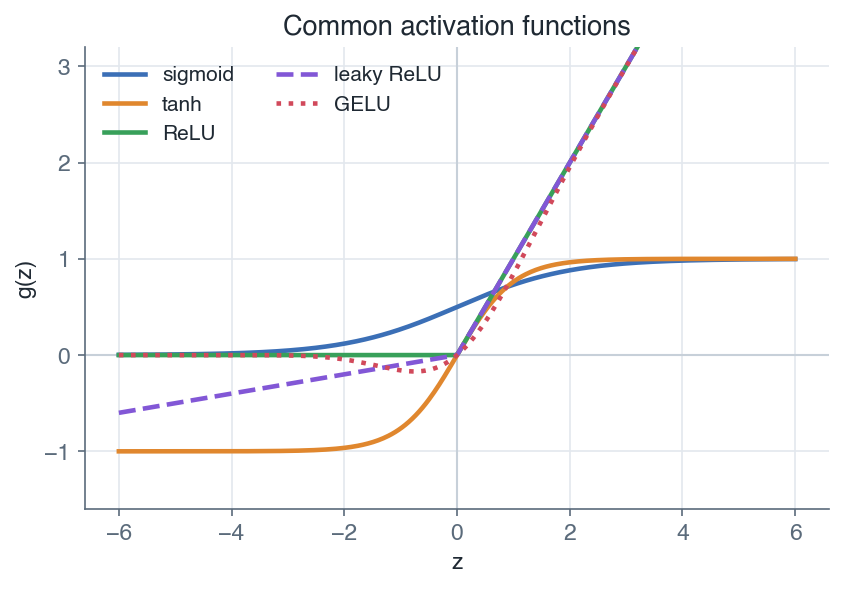
![Fonctions d'activation courantes tracées en fonction de z](/fr/Deep%20Learning/02%20Activation%20functions/a/activation-functions.png)
36084c lugonthier 2026-07-02 14:39:19
Add new content and images for Linear Models, Regularization, SVMs, and Decision Trees - Added images for linear regression, logistic regression, and perceptron. - Introduced a new section on Regularization and High-Dimensional Inference with detailed explanations and images. - Added content on Support Vector Machines, including definitions, loss functions, and kernel methods. - Created a new section on Decision Trees and Ensemble Methods, covering CART, bagging, random forests, and boosting. - Included relevant images to illustrate concepts in Decision Trees and Ensemble Methods.
18
19
*Fonctions d'activation courantes : la sigmoïde et la tanh, bornées, saturent dans leurs queues, tandis que ReLU et ses variantes restent linéaires pour les entrées positives.*
20
12d21f lugonthier 2026-07-24 11:49:19
Remove unused SVG files and update Markdown content for clarity and accuracy in MLOps and Machine Learning modules. Adjust references to optimization techniques and activation functions, and enhance explanations in the mathematical refresher section.
21
### 2.2.1 Sigmoïde
36084c lugonthier 2026-07-02 14:39:19
Add new content and images for Linear Models, Regularization, SVMs, and Decision Trees - Added images for linear regression, logistic regression, and perceptron. - Introduced a new section on Regularization and High-Dimensional Inference with detailed explanations and images. - Added content on Support Vector Machines, including definitions, loss functions, and kernel methods. - Created a new section on Decision Trees and Ensemble Methods, covering CART, bagging, random forests, and boosting. - Included relevant images to illustrate concepts in Decision Trees and Ensemble Methods.
22
23
La sigmoïde écrase n'importe quelle pré-activation réelle dans l'intervalle ouvert $(0, 1)$ :
24
25
$$\boxed{ \sigma(z) = \frac{1}{1 + e^{-z}} \in (0, 1) }$$
26
27
Sa dérivée admet la forme close pratique ci-dessous, qui réutilise la valeur avant $\sigma(z)$ déjà calculée :
28
29
$$\boxed{ \sigma'(z) = \sigma(z)\left(1 - \sigma(z)\right) }$$
30
12d21f lugonthier 2026-07-24 11:49:19
Remove unused SVG files and update Markdown content for clarity and accuracy in MLOps and Machine Learning modules. Adjust references to optimization techniques and activation functions, and enhance explanations in the mathematical refresher section.
31
### 2.2.2 Tanh
36084c lugonthier 2026-07-02 14:39:19
Add new content and images for Linear Models, Regularization, SVMs, and Decision Trees - Added images for linear regression, logistic regression, and perceptron. - Introduced a new section on Regularization and High-Dimensional Inference with detailed explanations and images. - Added content on Support Vector Machines, including definitions, loss functions, and kernel methods. - Created a new section on Decision Trees and Ensemble Methods, covering CART, bagging, random forests, and boosting. - Included relevant images to illustrate concepts in Decision Trees and Ensemble Methods.
32
33
La tangente hyperbolique est une sigmoïde remise à l'échelle et centrée en zéro, dont la sortie est dans $(-1, 1)$. Sa dérivée s'exprime elle aussi à partir de la valeur avant :
34
35
$$\boxed{ \tanh'(z) = 1 - \tanh(z)^2 }$$
36
37
*Remarque :* $\tanh$ est centrée en zéro alors que $\sigma$ ne l'est pas, si bien que $\tanh$ s'entraîne souvent un peu mieux comme activation cachée. Les deux sont reliées par $\tanh(z) = 2\sigma(2z) - 1$.
38
12d21f lugonthier 2026-07-24 11:49:19
Remove unused SVG files and update Markdown content for clarity and accuracy in MLOps and Machine Learning modules. Adjust references to optimization techniques and activation functions, and enhance explanations in the mathematical refresher section.
39
### 2.2.3 Saturation
36084c lugonthier 2026-07-02 14:39:19
Add new content and images for Linear Models, Regularization, SVMs, and Decision Trees - Added images for linear regression, logistic regression, and perceptron. - Introduced a new section on Regularization and High-Dimensional Inference with detailed explanations and images. - Added content on Support Vector Machines, including definitions, loss functions, and kernel methods. - Created a new section on Decision Trees and Ensemble Methods, covering CART, bagging, random forests, and boosting. - Included relevant images to illustrate concepts in Decision Trees and Ensemble Methods.
40
12d21f lugonthier 2026-07-24 11:49:19
Remove unused SVG files and update Markdown content for clarity and accuracy in MLOps and Machine Learning modules. Adjust references to optimization techniques and activation functions, and enhance explanations in the mathematical refresher section.
41
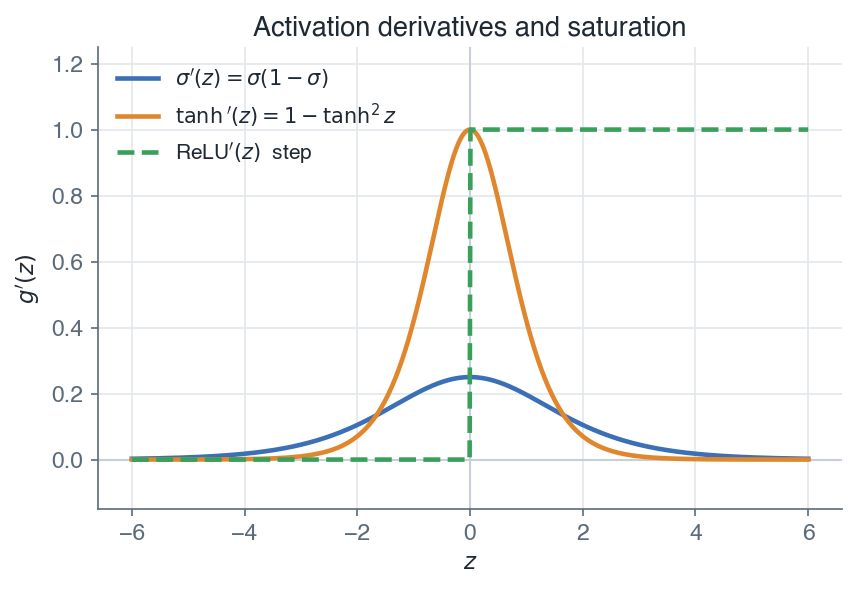
Les deux courbes s'aplatissent dans leurs queues. Pour de grandes valeurs de $|z|$, la sortie est proche d'une constante ($0$ ou $1$ pour $\sigma$, $\pm 1$ pour $\tanh$), donc la dérivée est proche de zéro : $\sigma'(z) \to 0$ et $\tanh'(z) \to 0$. Une unité située dans cette région plate est dite saturée, et elle ne transmet presque aucun gradient vers l'arrière. Lorsque de nombreux facteurs de ce type se multiplient à travers un empilement profond, le gradient tend vers zéro : c'est la disparition du gradient, rendue précise dans la section suivante.
36084c lugonthier 2026-07-02 14:39:19
Add new content and images for Linear Models, Regularization, SVMs, and Decision Trees - Added images for linear regression, logistic regression, and perceptron. - Introduced a new section on Regularization and High-Dimensional Inference with detailed explanations and images. - Added content on Support Vector Machines, including definitions, loss functions, and kernel methods. - Created a new section on Decision Trees and Ensemble Methods, covering CART, bagging, random forests, and boosting. - Included relevant images to illustrate concepts in Decision Trees and Ensemble Methods.
42
12d21f lugonthier 2026-07-24 11:49:19
Remove unused SVG files and update Markdown content for clarity and accuracy in MLOps and Machine Learning modules. Adjust references to optimization techniques and activation functions, and enhance explanations in the mathematical refresher section.
43
![Dérivées de la sigmoïde, de la tanh et de ReLU en fonction de z](/fr/Deep%20Learning/02%20Activation%20functions/a/activation-derivatives.png)
36084c lugonthier 2026-07-02 14:39:19
Add new content and images for Linear Models, Regularization, SVMs, and Decision Trees - Added images for linear regression, logistic regression, and perceptron. - Introduced a new section on Regularization and High-Dimensional Inference with detailed explanations and images. - Added content on Support Vector Machines, including definitions, loss functions, and kernel methods. - Created a new section on Decision Trees and Ensemble Methods, covering CART, bagging, random forests, and boosting. - Included relevant images to illustrate concepts in Decision Trees and Ensemble Methods.
44
45
*Dérivées des activations : les gradients de la sigmoïde et de la tanh disparaissent dans les queues, tandis que le gradient de ReLU vaut 1 partout où l'unité est active.*
46
12d21f lugonthier 2026-07-24 11:49:19
Remove unused SVG files and update Markdown content for clarity and accuracy in MLOps and Machine Learning modules. Adjust references to optimization techniques and activation functions, and enhance explanations in the mathematical refresher section.
47
## 2.3 La disparition du gradient
48
49
La saturation n'est pas un défaut cosmétique, elle décide si une pile profonde peut s'entraîner tout court. La rétropropagation multiplie l'erreur par la pente locale $g'(z^{[l]})$ à chaque couche traversée, si bien que le gradient qui atteint la couche 1 contient un tel facteur par couche. Avec des activations sigmoïdes, ces facteurs sont petits par construction : la section 2.2.1 a donné $\sigma'(z) = \sigma(z)(1 - \sigma(z))$, et ce produit ne dépasse jamais
50
51
$$\boxed{ \sigma'(z) = \sigma(z)\left(1 - \sigma(z)\right) \le \tfrac{1}{4} }$$
52
53
Le résultat est la disparition du gradient : les couches proches de la sortie apprennent, celles proches de l'entrée ne reçoivent presque rien et bougent à peine. Les réseaux sigmoïdes profonds stagnent, et le remède n'est pas un meilleur optimiseur, c'est une meilleure activation, la ReLU de la section suivante.
54
55
<details class="proof">
56
<summary>Preuve : le gradient rétrécit géométriquement avec la profondeur</summary>
57
58
**Étape 1 : la pente de la sigmoïde ne dépasse jamais $1/4$.** Posons $s = \sigma(z) \in (0, 1)$ : le produit $s(1 - s)$ est une parabole tournée vers le bas, maximale en $s = \tfrac{1}{2}$ où elle vaut $\tfrac{1}{4}$. La borne tient donc, avec égalité seulement en $z = 0$, et la saturation aggrave tout : une unité située à $\sigma(2) \approx 0{,}88$ a déjà une pente de $0{,}88 \cdot 0{,}12 \approx 0{,}10$.
59
60
**Étape 2 : la rétropropagation multiplie ces pentes.** Prenons le réseau profond le plus simple, une chaîne de $L$ couches à une unité chacune, où chaque quantité est un scalaire. Chaque couche traversée apporte le facteur $\partial z^{[l]} / \partial z^{[l-1]} = w^{[l]}\, \sigma'(z^{[l-1]})$ :
61
62
$$\frac{\partial L}{\partial z^{[1]}} = \frac{\partial L}{\partial z^{[L]}} \prod_{l=2}^{L} w^{[l]}\, \sigma'(z^{[l-1]})$$
63
64
Avec des poids de taille typique $|w^{[l]}| \le 1$, chaque facteur vaut au plus $\tfrac{1}{4}$ en valeur absolue, donc
65
66
$$\boxed{ \left|\frac{\partial L}{\partial z^{[1]}}\right| \le \left(\tfrac{1}{4}\right)^{L-1} \left|\frac{\partial L}{\partial z^{[L]}}\right| }$$
67
68
Dix couches rétrécissent déjà le gradient d'environ $10^{-6}$. $\blacksquare$
69
70
</details>
71
72
Des poids bien plus grands que $1$ ne font qu'échanger le problème contre son image miroir, l'explosion du gradient. [Entraîner les réseaux profonds](/fr/Deep%20Learning/04%20Training%20deep%20networks) choisit l'échelle des poids pour que ce produit reste proche de $1$.
73
74
## 2.4 La famille ReLU
36084c lugonthier 2026-07-02 14:39:19
Add new content and images for Linear Models, Regularization, SVMs, and Decision Trees - Added images for linear regression, logistic regression, and perceptron. - Introduced a new section on Regularization and High-Dimensional Inference with detailed explanations and images. - Added content on Support Vector Machines, including definitions, loss functions, and kernel methods. - Created a new section on Decision Trees and Ensemble Methods, covering CART, bagging, random forests, and boosting. - Included relevant images to illustrate concepts in Decision Trees and Ensemble Methods.
75
76
L'unité linéaire rectifiée conserve la partie positive de son entrée et annule le reste :
77
78
$$\boxed{ \text{ReLU}(z) = \max(0, z) }$$
79
80
Sa dérivée vaut $1$ pour $z > 0$ et $0$ pour $z < 0$ (non définie en $z = 0$, prise égale à $0$ ou $1$ par convention). ReLU ne sature pas du côté positif, elle y maintient donc un gradient sain, ce qui explique en grande partie pourquoi elle est devenue l'activation cachée par défaut. Le prix à payer est le problème des unités mortes : si la pré-activation d'une unité est toujours négative sur l'ensemble des données, son gradient est toujours nul et elle cesse complètement d'apprendre. Les variantes ci-dessous sacrifient un peu de simplicité pour adoucir cette défaillance ou lisser le point anguleux à l'origine.
81
82
| nom | formule | dérivée | meurt / sature ? |
83
| --- | --- | --- | --- |
84
| ReLU | $\max(0, z)$ | $1$ if $z>0$ else $0$ | peut mourir (gradient nul pour $z<0$) |
85
| Leaky ReLU | $\max(\alpha z, z)$, $\alpha \approx 0.01$ | $1$ if $z>0$ else $\alpha$ | meurt rarement (petite pente négative) |
86
| PReLU | $\max(\alpha z, z)$, $\alpha$ learned | $1$ if $z>0$ else $\alpha$ | meurt rarement ($\alpha$ appris par canal) |
87
| ELU | $z$ if $z>0$ else $\alpha(e^z - 1)$ | $1$ if $z>0$ else $\alpha e^z$ | sature doucement pour $z\to-\infty$ |
88
| GELU | $z\,\Phi(z)$, $\Phi$ the normal CDF | lisse, proche de $1$ pour de grands $z$ | lisse, pas de mort brutale |
89
90
*Remarque :* leaky ReLU et PReLU ajoutent une petite pente $\alpha$ du côté négatif afin qu'une unité ne soit jamais complètement éteinte. GELU pondère l'entrée par la probabilité $\Phi(z)$ qu'une loi normale standard soit inférieure à $z$, ce qui donne une courbe lisse se comportant comme ReLU pour de grandes valeurs de $|z|$. C'est le choix standard à l'intérieur des Transformers.
91
12d21f lugonthier 2026-07-24 11:49:19
Remove unused SVG files and update Markdown content for clarity and accuracy in MLOps and Machine Learning modules. Adjust references to optimization techniques and activation functions, and enhance explanations in the mathematical refresher section.
92
## 2.5 Softmax pour les sorties multiclasses
36084c lugonthier 2026-07-02 14:39:19
Add new content and images for Linear Models, Regularization, SVMs, and Decision Trees - Added images for linear regression, logistic regression, and perceptron. - Introduced a new section on Regularization and High-Dimensional Inference with detailed explanations and images. - Added content on Support Vector Machines, including definitions, loss functions, and kernel methods. - Created a new section on Decision Trees and Ensemble Methods, covering CART, bagging, random forests, and boosting. - Included relevant images to illustrate concepts in Decision Trees and Ensemble Methods.
93
94
Pour une classification à $K$ classes, la couche finale produit un vecteur $z \in \mathbb{R}^K$ de scores, et la softmax le transforme en une distribution de probabilité sur les classes :
95
96
$$\boxed{ \text{softmax}(z)_k = \frac{e^{z_k}}{\sum_{j=1}^{K} e^{z_j}} }$$
97
98
Chaque composante appartient à $(0, 1)$ et les composantes somment à $1$, si bien que $\text{softmax}(z)_k$ se lit comme la probabilité prédite de la classe $k$. Le plus grand score devient la classe la plus probable.
99
12d21f lugonthier 2026-07-24 11:49:19
Remove unused SVG files and update Markdown content for clarity and accuracy in MLOps and Machine Learning modules. Adjust references to optimization techniques and activation functions, and enhance explanations in the mathematical refresher section.
100
*Remarque :* la softmax a sa place dans la couche de sortie, pas dans une couche cachée. Elle couple chaque unité par le dénominateur partagé (une normalisation sur tout le vecteur), ce qui est exactement ce dont une sortie probabiliste a besoin mais ne constitue pas une non-linéarité cachée utile par unité. Pour une sortie unique ($K = 1$ contre son complément), la softmax se réduit à la sigmoïde. L'association de la softmax avec sa fonction de perte a été réglée dans la section 6.3 de [Réseaux de neurones multi-couches](/fr/Machine%20Learning/06%20Multilayer%20neural%20networks).
36084c lugonthier 2026-07-02 14:39:19
Add new content and images for Linear Models, Regularization, SVMs, and Decision Trees - Added images for linear regression, logistic regression, and perceptron. - Introduced a new section on Regularization and High-Dimensional Inference with detailed explanations and images. - Added content on Support Vector Machines, including definitions, loss functions, and kernel methods. - Created a new section on Decision Trees and Ensemble Methods, covering CART, bagging, random forests, and boosting. - Included relevant images to illustrate concepts in Decision Trees and Ensemble Methods.
101
12d21f lugonthier 2026-07-24 11:49:19
Remove unused SVG files and update Markdown content for clarity and accuracy in MLOps and Machine Learning modules. Adjust references to optimization techniques and activation functions, and enhance explanations in the mathematical refresher section.
102
## 2.6 Choisir une activation
36084c lugonthier 2026-07-02 14:39:19
Add new content and images for Linear Models, Regularization, SVMs, and Decision Trees - Added images for linear regression, logistic regression, and perceptron. - Introduced a new section on Regularization and High-Dimensional Inference with detailed explanations and images. - Added content on Support Vector Machines, including definitions, loss functions, and kernel methods. - Created a new section on Decision Trees and Ensemble Methods, covering CART, bagging, random forests, and boosting. - Included relevant images to illustrate concepts in Decision Trees and Ensemble Methods.
103
104
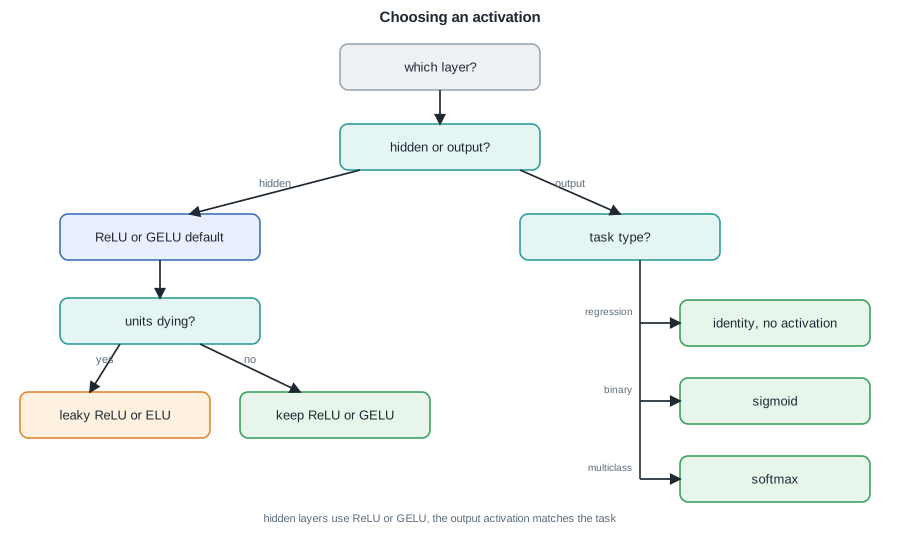
Un bon choix par défaut : utiliser ReLU ou GELU dans les couches cachées, et choisir l'activation de sortie selon la tâche. Le schéma et le tableau ci-dessous résument la décision.
105
12d21f lugonthier 2026-07-24 11:49:19
Remove unused SVG files and update Markdown content for clarity and accuracy in MLOps and Machine Learning modules. Adjust references to optimization techniques and activation functions, and enhance explanations in the mathematical refresher section.
106
![Flux de décision pour choisir une activation par couche](/fr/Deep%20Learning/02%20Activation%20functions/a/activation-choice.svg)
36084c lugonthier 2026-07-02 14:39:19
Add new content and images for Linear Models, Regularization, SVMs, and Decision Trees - Added images for linear regression, logistic regression, and perceptron. - Introduced a new section on Regularization and High-Dimensional Inference with detailed explanations and images. - Added content on Support Vector Machines, including definitions, loss functions, and kernel methods. - Created a new section on Decision Trees and Ensemble Methods, covering CART, bagging, random forests, and boosting. - Included relevant images to illustrate concepts in Decision Trees and Ensemble Methods.
107
108
*Choisir une activation : ReLU ou GELU pour les couches cachées, et une activation de sortie adaptée à la tâche.*
109
110
| couche / tâche | activation recommandée | raison |
111
| --- | --- | --- |
112
| cachée (par défaut) | ReLU ou GELU | pas de saturation du côté positif, peu coûteuse, entraînement rapide |
113
| cachée (unités mortes) | leaky ReLU ou ELU | conserve un gradient non nul pour $z < 0$ |
114
| sortie, régression | identité (aucune) | la prédiction est une valeur réelle non bornée |
115
| sortie, binaire | sigmoïde | transforme le score en une probabilité dans $(0, 1)$ |
116
| sortie, multiclasse | softmax | transforme les scores en une distribution sur les classes |
117
118
*Remarque :* la sigmoïde et la tanh sont aujourd'hui rarement utilisées comme activations cachées dans les réseaux profonds à propagation avant, précisément à cause de la saturation vue à la Section 3.2.3. Elles subsistent en sortie (sigmoïde) et à l'intérieur des unités récurrentes à portes, où leur plage bornée est justement recherchée.
119
12d21f lugonthier 2026-07-24 11:49:19
Remove unused SVG files and update Markdown content for clarity and accuracy in MLOps and Machine Learning modules. Adjust references to optimization techniques and activation functions, and enhance explanations in the mathematical refresher section.
120
*Une fois les non-linéarités par couche fixées, la prochaine leçon transforme les gradients en mises à jour : les optimiseurs qui rendent l'entraînement profond praticable.*
36084c lugonthier 2026-07-02 14:39:19
Add new content and images for Linear Models, Regularization, SVMs, and Decision Trees - Added images for linear regression, logistic regression, and perceptron. - Introduced a new section on Regularization and High-Dimensional Inference with detailed explanations and images. - Added content on Support Vector Machines, including definitions, loss functions, and kernel methods. - Created a new section on Decision Trees and Ensemble Methods, covering CART, bagging, random forests, and boosting. - Included relevant images to illustrate concepts in Decision Trees and Ensemble Methods.
121
122
---
12d21f lugonthier 2026-07-24 11:49:19
Remove unused SVG files and update Markdown content for clarity and accuracy in MLOps and Machine Learning modules. Adjust references to optimization techniques and activation functions, and enhance explanations in the mathematical refresher section.
123
Suivant : [Optimisation](/fr/Deep%20Learning/03%20Optimization) · [Vue d'ensemble du cours](/fr/Deep%20Learning)